Can he create a rock so big, even he himself could not lift it?
Whoa.
This question is rather old, yet is continually brought up as if it's a new one, and continually stumps any theist, though it's usually used against Christians in particular. The trump is set up with a few questions pitched at the believer which the inquisitor is sure will result in a strong and assured "yes."
"Do you believe in God?"
"Yes."
"Do you believe God is all powerful?"
"Yes."
"Do you believe God can do anything?"
"Yes!"
"Then answer me this: if your God is so powerful, can he create a rock so big, even he himself could not lift it?"
Actually the question makes a very good point, and I'd even say that it's pretense is right on. It's pointing out how a God who is all powerful, and can do anything doesn't make sense. I agree-- it doesn't make any sense. A lot of angry Christians have said in response "Well, that question just doesn't make any sense!" My fellow believers, I'm sorry, but you're wrong: the question makes perfect sense, and the non-believer is right. It's not the question, but the God itself that does not make sense.
Now, here's where we get tripped up:
"Do you believe God can do anything?"
You should say no, because
GOD CAN'T DO ANYTHING
The believer really does have a good heart desire: they love God, think very highly of Him, and are eager to come to the defense of anyone questioning the Lord's eternal qualities. OF COURSE they're going to say God can do anything-- a higher being who can do anything is pretty much what the whole idea of God is based around! But in the case of the Judeo-Christian God, there are things that God cannot do, and you'll see what I'm talking about here:
-God can't lie
-God can't go against his Word
-God can't not do something he said he will
-God can't do something he said he wouldn't
(which is why)
-God can't destroy Satan
-God can't flood the earth a second time
-God can't self-destruct, or end his existence
-God can't create something that doesn't make sense
-God can't create anything beyond himself, since adding to what is already infinite simply is not possible. Despite what 7-year-olds would have us believe, there is no infinity+1
(and therefore)
-God can't create a rock so big, even he himself could not lift it.
Make sense? Our God is all-powerful (meaning whatever can be done, He has the power to do), but that doesn't mean He can do anything. Ready for another humdinger? Can God imagine vastness, such as the vastness of eternity? I'd say no, God can't imagine vastness because it requires him to imagine something beyond himself, against which he can measure. That is impossible, for God is all, and cannot be measured against, or beyond.
Friday, December 17, 2010


Monday, November 29, 2010
Time is Meaningless
This is going to be a weird one.
Since I was a young lad, I've been very familiar with the idea of heaven. Really, don't most people believe in heaven, somehow? For the most part, yes, especially when it comes to loved ones passing away-- everyone believes their grandma/uncle/best friend went to heaven. Now, whether they themselves are also going to heaven is something a lot of people assume, and if not, it's just not something they think about.
Heaven is . . . peaceful? Painless? Happy?
. . . Eternal?
Sure, sure, why not? But have you ever considered what eternity really means? I have, and to be perfectly, vulnerably honest, it kinda scares me. It blows my mind, for one thing. All I have to do is think about the idea of eternity for about 2 seconds, and I'm done; my mind is blown. It keeps going? Life never stops? There is no end to existence?
This really is something that can't be imagined, and that's why it blows your mind. Someone who doesn't believe in God, and therefore, heaven, may be moved to think:
"yeah, that's why I'm glad I don't believe in it, because it doesn't make sense."
But you have to believe in eternity, whether or not you even believe in God, because after you die, the universe will go on, and on, and on, and even ten quintillion years from now, when the universe will supposedly collapse on itself and end up as a single, infinitely small black hole singularity, time will still go one. So yes, everyone must believe in eternity.
But I suppose the idea that you'll be around for it is what makes it scary in light of it's never-endingness. For a long time, I've found myself with the heebie-jeebies when I think of myself being eternal. These heebie-jeebies also leave me feeling a bit guilty because I know that eternity spent in the company of my infinitely loving, infinitely knowledgeable, infinitely perfect Jesus would be full of joy and wonder. I mean, what kind of Christian am I to be scared of spending eternity with God?
But I've had a thought in recent weeks that I've found comforting. A thought which has, for the most part, dissolved my fear of spending eternity with God.
There is no time in eternity.
I've realized that the idea of time in light of eternity is quite ridiculous. It's not as though eternity will have "begun," or "keep going," or anything of the sort. It's not as though, epochs into my future with the Lord, I'll look back and say "Wow, it's year 15,587,000,072,576. Cool!" There will be no new establishment of time markation, as if there is a new year zero, and we can begin measuring again from that point.
Eternity will not have begun. Rather, eternity will be a new state.
Looking back at past instances in my life where my belief in God was challenged in relation to various aspects of God's existence, I wish I understood then what I do now. There's obviously the paradox of the Trinity (one god that is three gods, somehow) to tangle with, but I'm not going to go there right now because I think it's impossible to explain (and 2000 years' worth of great theologians would concur). But consider how people wrangle (Christians included) with the idea that God has always existed; how is that supposed to make sense? "If God wasn't created, where did he come from?" we're asked. "How can God exist if he never began?" The typical theist's response is that "God is surely outside of time," or that "time does not apply to God," which is scoffed at by the inquisitor, and rightly so. The response given by the believer is playing right into the hands of the inquisitor, as it fails to address the real question, which should be:
"How can you say that time even exists?"
Because, as a concept, time is not particularly founded. What is it? How does one measure time? Really, when you come down to it, time is just a human method of understanding the universe. It is impossible to prove time. So, when we're asking how God exists if he never began, we're not getting the whole picture. The truth is, the very concept of "beginning" itself implies time. To try and shoehorn the idea of an infinite God into something like time, which is entirely a human idea that cannot be proved, is absurd.
To add, most people today who do not believe in God, when questioned on the origin of the universe, would reply that they believe in the Big Bang. But frankly, I find it much easier to accept the idea of an omnipotent God to whom time does not apply, than to accept the idea of everything somehow coming out of nothing at some distant point in the past. A Big Bang needs a catalyst, and a catalyst could not simply manifest itself out of nothingness. The problem with the Big Bang is that it tries to fit the idea of existence as having begun at some point, i.e., time. But at least belief in a God existing outside of time puts the question out of our ability to answer.
It's not like you're going to be able to explain the existence of existence anyway, so you might as well point to a God to explain it all. At that point, at least you can say it's out of your hands.
It's a long time coming, but here is my point:
Scripture says that when we see the Lord in heaven, we will become like him. Here we find ourselves essentially sharing in his God-nature thanks to our union with God through Jesus Christ. If time is a human concept, one that does not apply to an infinite being such as God, then time will no longer apply to us, either. Eternity will be our new state. Do you think God fears the vastness of eternity? No, because there is no timeline to His eternity-- it is simply his state. And eternity will be our state, too, then, and thus, there is nothing to fear.
We will be like God.
Since I was a young lad, I've been very familiar with the idea of heaven. Really, don't most people believe in heaven, somehow? For the most part, yes, especially when it comes to loved ones passing away-- everyone believes their grandma/uncle/best friend went to heaven. Now, whether they themselves are also going to heaven is something a lot of people assume, and if not, it's just not something they think about.
Heaven is . . . peaceful? Painless? Happy?
. . . Eternal?
Sure, sure, why not? But have you ever considered what eternity really means? I have, and to be perfectly, vulnerably honest, it kinda scares me. It blows my mind, for one thing. All I have to do is think about the idea of eternity for about 2 seconds, and I'm done; my mind is blown. It keeps going? Life never stops? There is no end to existence?
This really is something that can't be imagined, and that's why it blows your mind. Someone who doesn't believe in God, and therefore, heaven, may be moved to think:
"yeah, that's why I'm glad I don't believe in it, because it doesn't make sense."
But you have to believe in eternity, whether or not you even believe in God, because after you die, the universe will go on, and on, and on, and even ten quintillion years from now, when the universe will supposedly collapse on itself and end up as a single, infinitely small black hole singularity, time will still go one. So yes, everyone must believe in eternity.
But I suppose the idea that you'll be around for it is what makes it scary in light of it's never-endingness. For a long time, I've found myself with the heebie-jeebies when I think of myself being eternal. These heebie-jeebies also leave me feeling a bit guilty because I know that eternity spent in the company of my infinitely loving, infinitely knowledgeable, infinitely perfect Jesus would be full of joy and wonder. I mean, what kind of Christian am I to be scared of spending eternity with God?
But I've had a thought in recent weeks that I've found comforting. A thought which has, for the most part, dissolved my fear of spending eternity with God.
There is no time in eternity.
I've realized that the idea of time in light of eternity is quite ridiculous. It's not as though eternity will have "begun," or "keep going," or anything of the sort. It's not as though, epochs into my future with the Lord, I'll look back and say "Wow, it's year 15,587,000,072,576. Cool!" There will be no new establishment of time markation, as if there is a new year zero, and we can begin measuring again from that point.
Eternity will not have begun. Rather, eternity will be a new state.
Looking back at past instances in my life where my belief in God was challenged in relation to various aspects of God's existence, I wish I understood then what I do now. There's obviously the paradox of the Trinity (one god that is three gods, somehow) to tangle with, but I'm not going to go there right now because I think it's impossible to explain (and 2000 years' worth of great theologians would concur). But consider how people wrangle (Christians included) with the idea that God has always existed; how is that supposed to make sense? "If God wasn't created, where did he come from?" we're asked. "How can God exist if he never began?" The typical theist's response is that "God is surely outside of time," or that "time does not apply to God," which is scoffed at by the inquisitor, and rightly so. The response given by the believer is playing right into the hands of the inquisitor, as it fails to address the real question, which should be:
"How can you say that time even exists?"
Because, as a concept, time is not particularly founded. What is it? How does one measure time? Really, when you come down to it, time is just a human method of understanding the universe. It is impossible to prove time. So, when we're asking how God exists if he never began, we're not getting the whole picture. The truth is, the very concept of "beginning" itself implies time. To try and shoehorn the idea of an infinite God into something like time, which is entirely a human idea that cannot be proved, is absurd.
To add, most people today who do not believe in God, when questioned on the origin of the universe, would reply that they believe in the Big Bang. But frankly, I find it much easier to accept the idea of an omnipotent God to whom time does not apply, than to accept the idea of everything somehow coming out of nothing at some distant point in the past. A Big Bang needs a catalyst, and a catalyst could not simply manifest itself out of nothingness. The problem with the Big Bang is that it tries to fit the idea of existence as having begun at some point, i.e., time. But at least belief in a God existing outside of time puts the question out of our ability to answer.
It's not like you're going to be able to explain the existence of existence anyway, so you might as well point to a God to explain it all. At that point, at least you can say it's out of your hands.
It's a long time coming, but here is my point:
Scripture says that when we see the Lord in heaven, we will become like him. Here we find ourselves essentially sharing in his God-nature thanks to our union with God through Jesus Christ. If time is a human concept, one that does not apply to an infinite being such as God, then time will no longer apply to us, either. Eternity will be our new state. Do you think God fears the vastness of eternity? No, because there is no timeline to His eternity-- it is simply his state. And eternity will be our state, too, then, and thus, there is nothing to fear.
We will be like God.
Sunday, November 7, 2010
On The Immaculate Conception
I can't believe I'm doing this . . .
I am not writing this to convince you of the truth of this Catholic Dogma.
I myself am not wholly convinced of this Dogma's truth.
I am writing this to convince you that this Catholic Dogma is not as unreasonable as you may think.
I hope you can come to at least give it that much credit.
Please read this with an open mind. Circumspection, I've come to see, is invaluable to those who wish for Christian unity, and to understand their brothers and sisters in Christ of another denomination.
Most of the Marian doctrines of the Catholic Church are not in place for Mary's sake, or for Mary's glory at all. Most of the Marian doctrines, you would be surprised to hear, are actually about/there to clarify the person of Jesus Christ.
No way.
The sad thing is that most Catholics don't even know that, and when the Catholic Church's own people misinterpret and misunderstand its reasons for certain beliefs . . . how can Protestants be expected to understand them? After all, we have to admit it: the Marian doctrines do sound kinda weird, and on the surface, many seem somewhat contrary to scripture. However, when you look back in history, you find that they actually came about as a way of explaining Jesus.
But we sorta take Jesus for granted today, or rather, we take understanding what he was for granted. Back in the first few hundred years of Christianity, there was no shortage of controversy regarding the incarnation, for example. People struggled internally and fought and argued externally over a lot of ideas and theology centered around Jesus.
-How could almighty God become a human?
-How much was Jesus God and how much was he a man?
-Did Jesus always know he was God?
-Did Jesus have two wills?
-Where does the Holy Spirit fit into the Father-Son relationship?
-If Jesus is God, and God is indestructible, how could God die?
-For that matter, how is it possible for God to suffer?
. . . among others; you get the idea.
When I first started learning of all these struggles and questions in the early church, I would often think things like:
"Seriously? Why is that important? I don't see how it affects my faith."
or
"Well, duh. Wasn't it obvious? Of course Jesus (fill in the blank)."
Now I'm a little older, a little wiser, and a little more open-minded. To answer my first thought: the more things change, the more they stay the same. There are things that Christians struggle with/argue about today that were totally off the radar back then, too. Every era of Christianity has its pet topics that don't tremendously affect the faith, but are nonetheless contentious among believers. To answer my second thought: well, of course it's obvious to me today, with 2000 years of Christian theology and understanding at my disposal. But how did we get that understanding? Why is it obvious to us? Because once upon a time, (insert random Christological fact) wasn't so obvious, and people had to struggle to figure it out.
Enter: the Marian doctrines, and their reason for being. You can't explain a lot of things about me, for example, without relating me to my parents. Take my last name, my near-sighted blue eyes, or my birthday--none of these things about me can be fully understood or explained without understanding my parents, or otherwise involving them in the discussion. So it is with Jesus and the Marian doctrines. No matter how weird or scripturally off they may seem, there is a reason for them to be, and those reasons, oddly enough, have nothing to do with Mary herself.
EXAMPLE:
The title "Mary, Mother of God"
WHAT IT SOUNDS LIKE:
Holy Cow! You're saying that Mary gave birth to God? What the heck does that imply? Calling her God's mother makes it sound like she's greater than God, or otherwise of a similar level or stature, which is pure blasphemy. And doesn't this mean that Mary came before God? No way.
ULTRA-LAME, TYPICAL CATHOLIC RESPONSE:
Well, of course Mary is the Mother of God-- she gave birth to Jesus, who is God! Therefore, she was God's mother. Duh, Protestants!
IMPORTANT DETAIL OVERLOOKED BY ALL:
English sucks. The original title is the Greek word Theotokos, which would be more accurately translated as "God-Bearer," or "Birth-Giver of God," which sounds a lot less blasphemous than "Mother of God."
WHAT CATHOLICS OUGHT TO SAY INSTEAD:
Mary was not given this title to make her look more holy, or even to give honor to her. In the early church, there were a good deal of Christians who rejected the union of God and man, and thus, saw Jesus as two different beings somehow coexisting. Those who believed this referred to Mary as Christokos, or "Mother of Christ," affirming her as the mother of only a human, not God. This division of the divine and human natures of Christ cheapens the incarnation, and therefore, the salvation of humanity. Therefore, to affirm the divinity and humanity of Jesus Christ, Mary was officially given the title Theotokos, or "Mother of God." Mother of God is there to affirm Jesus' divinity, not to make Mary look exalted.
See what I mean? Not as bad as you thought, right? Moving on to the Immaculate Conception . . .
The idea of the Immaculate Conception, roughly stated, is that Mary was conceived, through the miraculous power of God, without the stain of original sin, and thus led a sinless life.
NOOOOO, THE BIBLE SAYS ONLY JESUS WAS SINLESS!!!!
I know. Take a deep breath, my friends. Remember what I said at the beginning of this blog.
POINT 1:
Do you believe that you can be sinless, by the power of God? You should; the Bible says we can. Paul wouldn't talk about conforming to the whole image of Christ if it wasn't possible, since the whole image of Christ would obviously lack sin. This, of course, is all done through the grace of God, but rest assured, it is possible. Has anyone ever gotten there, ever? No one knows except God, but it's certainly possible, according to scripture (I'd wager that John made it). This too would seem to conflict with verses about everyone sinning except Jesus, unless you take into account that 1) this state of sinlessness is only obtained through the grace of god, and 2) those who achieve this state still have sinned, so it's not as though they don't need redeeming.
So, if I believe I can be sinless through the grace of God, why couldn't Mary have been sinless, too? After all, we know that grace is a gift, so it's not like Mary earned her state of sinlessness. Isn't it logical that God would give more grace to the person that would raise his son, than to a Midwestern, 20th century American Joe like me? Anyway, it's not like anyone's saying that Mary conceived herself immaculately. God's the one who did it; He gets the credit, and frankly, can't God do what He wants with His grace?
POINT 2:
We're all born into sin, right? Sin is the heritage that we receive from our parents: the sin nature, the flesh, the part of us that inherently rejects and disobeys God from the moment we are conceived. The stain of the original sin has been passed down through humanity ever since the beginning, and each of us is born into it ("surely I was sinful from the moment my mother conceived me," anyone?).
Well, if sin is a natural state passed on to each of us from the moment we enter our mother's womb, thanks to her own inherent sinfulness, which was inherent in her very humanity (thanks a lot, Adam!), in order for the chain of sinful birth to be broken, wouldn't Jesus have to have come from a sinless woman? If Jesus was born out of sin, as the rest of us are, wouldn't that have given him the same stain? Going further, the idea of Jesus as the "Second Adam" set forth in scripture necessitates a break from the line of sinful humans giving birth to sinful humans, and therefore, a new Adam would need to be conceived without a sinful parent.
By the way, if you are bothered by this idea because it implies that Mary didn't need redemption through Jesus' cross, consider this: who's to say that Mary didn't eventually sin after Jesus' birth, even if she was originally sinless? It's not like the sinless state is impossible to fall from, even if you're created that way. Just a thought . . .
That's all I really have to say in this blog. Remember, I just wanted you to think about this matter, and give it some circumspection. Even if you can't entirely swallow it (I have my struggles as well), I hope you at least see that it's not as looney or unreasonable as it initially comes across. Really, it's not even about Mary, or intended for her honor-- most of the Marian doctrines are not-- it's about Jesus.
Sunday, October 31, 2010
From Ignatius of Loyola
In 1491, Inigo de Loyola was born in what is today known as Basque Country, in northern Spain. He eventually became a soldier, and won many battles as a knight in the service of his lord, the Viceroy of Navarre. However, when his lord's fortress in Pamplona came under siege in 1521, Inigo was struck by a cannonball, which wounded one leg and shattered the bones in the other.
Inigo had to undergo extremely painful surgical procedures to repair the damage, after which he was laid up in bed recovering for nearly a year. During that time, Inigo had little to do, and he spent much of his time daydreaming. He had always desired to be in the service of a noble king, and that is what had lead him to become a knight. Inigo felt that if he could serve a benevolent lord with courage and devotion, he would have found his life's calling. Thus, much of his daydreaming focused on gallant deeds and heroic triumph in service of an imaginary, noble lord, as well as wooing a beautiful woman. Inigo ultimately found, though, that these daydreams left him feeling empty and exhausted.
At some point, Inigo was given a copy of De Vita Christi, a book written about the life of Jesus, a man whom Inigo had heard about all his life, but had never taken an interest in. Inigo was amazed by the self-sacrifice of the Lord Jesus, and subsequently, he wanted to read books on the saints-- those who had followed Jesus Christ selflessly, even to the death. As Inigo read more and more about Jesus and those who followed him, he began to feel that he himself was a fraud, a worthless soldier who had only sought what would bring him glory and prestige. Inigo felt shame at the lives of the saints and their utter devotion to God, in the face of his self-serving devotion to the Viceroy of Navarre.
It was at this point Inigo realized that his lifelong desire to serve a benevolent lord wasn't an impossible dream, but instead was staring him in the face: there is no more benevolent lord than the Lord Jesus Christ.
Furthermore, Inigo realized that these desires weren't merely of his flesh, as he had formerly thought, but were in fact planted in his heart from childhood by God to lead Inigo to Him.
Inigo decided to dedicate his life to God, and to serve Him forever. Inigo understood that in order to serve God, he had to empty himself of himself. He eventually took the name Ignacio, after a famous saint whose example he wished to follow, and founded the Society of Jesus, which we know today as the Jesuits.
This man changed history. But how does one change the world for the glory of God? With an attitude like this:
Conviction stirs my soul when I read this, and hopefully yours as well. If all Christians could have this attitude . . .
Inigo had to undergo extremely painful surgical procedures to repair the damage, after which he was laid up in bed recovering for nearly a year. During that time, Inigo had little to do, and he spent much of his time daydreaming. He had always desired to be in the service of a noble king, and that is what had lead him to become a knight. Inigo felt that if he could serve a benevolent lord with courage and devotion, he would have found his life's calling. Thus, much of his daydreaming focused on gallant deeds and heroic triumph in service of an imaginary, noble lord, as well as wooing a beautiful woman. Inigo ultimately found, though, that these daydreams left him feeling empty and exhausted.
At some point, Inigo was given a copy of De Vita Christi, a book written about the life of Jesus, a man whom Inigo had heard about all his life, but had never taken an interest in. Inigo was amazed by the self-sacrifice of the Lord Jesus, and subsequently, he wanted to read books on the saints-- those who had followed Jesus Christ selflessly, even to the death. As Inigo read more and more about Jesus and those who followed him, he began to feel that he himself was a fraud, a worthless soldier who had only sought what would bring him glory and prestige. Inigo felt shame at the lives of the saints and their utter devotion to God, in the face of his self-serving devotion to the Viceroy of Navarre.
It was at this point Inigo realized that his lifelong desire to serve a benevolent lord wasn't an impossible dream, but instead was staring him in the face: there is no more benevolent lord than the Lord Jesus Christ.
Furthermore, Inigo realized that these desires weren't merely of his flesh, as he had formerly thought, but were in fact planted in his heart from childhood by God to lead Inigo to Him.
Inigo decided to dedicate his life to God, and to serve Him forever. Inigo understood that in order to serve God, he had to empty himself of himself. He eventually took the name Ignacio, after a famous saint whose example he wished to follow, and founded the Society of Jesus, which we know today as the Jesuits.
This man changed history. But how does one change the world for the glory of God? With an attitude like this:
"Take, O Lord, and receive my entire liberty, my memory, my understanding and my whole will. All that I am and all that I possess You have given me. I surrender it all to You to be disposed of according to Your will. Give me only Your love and Your grace; with these I will be rich enough, and will desire nothing more"
Conviction stirs my soul when I read this, and hopefully yours as well. If all Christians could have this attitude . . .
Monday, October 18, 2010
A psalm of thanks
Praise be to God, the almighty father
He alone knows all things
He alone has planned all things
They said to me: Surely, God has not planned this
Surely, you have missed God's call
For the Lord rewards those who follow Him
And from those who do not follow Him
He withholds his blessing
And you are clearly not blessed
But I sought the Lord, and he allowed me to find Him
I said to God: Here I am, use me Lord
To you I dedicate my life
My will is to do your will in all things
I asked God to direct my steps, and He led my feet
I asked him to teach me, and He taught wisdom
He did not repay my shortsightedness with scorn
Nor did he look upon my doubts
as if they were a withdrawal of my commitments
God did not pay me restitution for my pride
nor the consequences of my sins
The Lord is gracious and generous
His rewards are not as we see them
nor his instructions as we would expect
His ways are beyond our ways
And his plans much further than our plans
I sought the Lord and he answered me
He did not answer me in the manner which I expected
Or with the things I expected an answer from
But the Lord did indeed answer me.
I did not perceive His ways
But he taught me them nonetheless
I did not fathom God's goodness
But he graced me with it despite my imprudence
selah
I wish to make the Most High my dwelling place
There will I find peace, there I will stay
He has brought me thus far, and I will not doubt Him
The Lord is good to those who love Him always
Always is the Lord good.
He alone knows all things
He alone has planned all things
They said to me: Surely, God has not planned this
Surely, you have missed God's call
For the Lord rewards those who follow Him
And from those who do not follow Him
He withholds his blessing
And you are clearly not blessed
But I sought the Lord, and he allowed me to find Him
I said to God: Here I am, use me Lord
To you I dedicate my life
My will is to do your will in all things
I asked God to direct my steps, and He led my feet
I asked him to teach me, and He taught wisdom
He did not repay my shortsightedness with scorn
Nor did he look upon my doubts
as if they were a withdrawal of my commitments
God did not pay me restitution for my pride
nor the consequences of my sins
The Lord is gracious and generous
His rewards are not as we see them
nor his instructions as we would expect
His ways are beyond our ways
And his plans much further than our plans
I sought the Lord and he answered me
He did not answer me in the manner which I expected
Or with the things I expected an answer from
But the Lord did indeed answer me.
I did not perceive His ways
But he taught me them nonetheless
I did not fathom God's goodness
But he graced me with it despite my imprudence
selah
I wish to make the Most High my dwelling place
There will I find peace, there I will stay
He has brought me thus far, and I will not doubt Him
The Lord is good to those who love Him always
Always is the Lord good.
Wednesday, October 13, 2010
Just in case I gave you the wrong idea
I only write in this blog about what I've come to see as definite. It's Kevin-Brand Theology, which is generic at best, and most stores don't even carry it in stock.
I have a tag for short little posts like this, "Kevin on Kevin's ideas," not because I think I'm just that darn important, and can't get enough of talking about myself. Rather, I have that tag and I write these quick little entries to give you the sense that
It may seem like I do, given how certain of a tone I can take in these blogs. But I want you to know that:
a) I only write about things that I'm fairly certain on, so you don't get to hear all the things that would make me shrug my shoulders like a sad bear and say " wwwww . . . idunno." Those would undoubtedly give you a better perspective on what I think of myself, but there's really no point in posting them-- I can't stand Christians who stir up a bunch of muck with high-minded questions and then sit back smugly and watch people scratch their heads, all the while pretending to be very modest by claiming no answers (and the blogosphere is full of these types).
b) I only write about those certain things after doing a lot of reading, head-scratching, annoying my wife with incessant questions, and so forth. And these blogs take me A LONG TIME to write-- several hours each, probably. So don't go thinking that this all just springs forth from my ivory towered head on a regular basis. There's a reason I only average two entries a month.
and
c) As far as this stuff being certain, you should know that I'm notorious for changing my mind. After all, you're reading the blog of an Evangelical/Pentecostal who became a Roman Catholic, which I'm sure indicates without saying that I done a lot of mind-changing.
The point is: am I certain? Right now I sure am. Will I always be? My record says otherwise. I may very well be embarrassed by reading this stuff someday.
I have a tag for short little posts like this, "Kevin on Kevin's ideas," not because I think I'm just that darn important, and can't get enough of talking about myself. Rather, I have that tag and I write these quick little entries to give you the sense that
I don't think I know everything.
It may seem like I do, given how certain of a tone I can take in these blogs. But I want you to know that:
a) I only write about things that I'm fairly certain on, so you don't get to hear all the things that would make me shrug my shoulders like a sad bear and say " wwwww . . . idunno." Those would undoubtedly give you a better perspective on what I think of myself, but there's really no point in posting them-- I can't stand Christians who stir up a bunch of muck with high-minded questions and then sit back smugly and watch people scratch their heads, all the while pretending to be very modest by claiming no answers (and the blogosphere is full of these types).
b) I only write about those certain things after doing a lot of reading, head-scratching, annoying my wife with incessant questions, and so forth. And these blogs take me A LONG TIME to write-- several hours each, probably. So don't go thinking that this all just springs forth from my ivory towered head on a regular basis. There's a reason I only average two entries a month.
and
c) As far as this stuff being certain, you should know that I'm notorious for changing my mind. After all, you're reading the blog of an Evangelical/Pentecostal who became a Roman Catholic, which I'm sure indicates without saying that I done a lot of mind-changing.
The point is: am I certain? Right now I sure am. Will I always be? My record says otherwise. I may very well be embarrassed by reading this stuff someday.
Tuesday, October 5, 2010
How I lost my belief in the rapture
Let me talk about the "rapture" with you. Bear with me if it takes a while to get to the topic of this entry's title; we must understand the base theology first.
The rapture is a doctrine that is fairly basic to anyone of a pentecostal background. The idea is that Jesus will snatch believers up to heaven either before, during, or right after the reign of the Antichrist, which is called the great tribulation in the book of Revelation. For all intents and purposes, though, when people refer to the "rapture," they're most likely referring to a pre-trib or mid-trib rapture, as the post-trib rapture is significantly different. The word itself literally refers to being "carried off;" figuratively, it is seen as a state of ecstasy on par with entering a new plane of existence that is one with happiness itself.
One might, say, feel "rapture" after being reunited with their long-lost spouse or child, who was believed to be dead.
"Rapture" itself isn't in the Bible (most theological terms are not, explicitly), but English speakers apply it referring to various scriptural passages because:
1) the obvious joy any believer would feel upon meeting Jesus Christ in all his glory
2) the very literal act of being carried off to be in heaven.
3) becoming one with the Lord in heaven would represent a new state of being, undoubtedly one that is perfect happiness
Argument of reason for the pre-trib rapture:
God would not want his church, his beloved bride, to be subject to the tribulation whatsoever. The church does not belong on Earth while the Antichrist is in power.
Argument of reason for the mid-trib rapture:
The rapture will occur once the second half of the tribulation begins (the trib is 7 years, altogether). The second half is far worse, as the Antichrist has seized total power over the Earth, and begins executing Christians left and right.
You know what's crazy? Pentecostals argue on these points quite thoroughly, and as I have always seen it, for no apparent reason. How does it affect our lives as Christians? Not at all, and yet . . . we're no better than Paul's Corinthians when it comes to the rapture, which is itself a unique and somewhat questionable doctrine, based in the pre-millenialist view of Revelation. I didn't always know that there were other ways of looking at Revelation, let alone that they were widely accepted within certain groups, and throughout certain periods of history. Among them are:
Now I want to get back to the rapture, specifically. It's based, again, in a pre-millennialist view of the book of Revelation, that being that we are currently awaiting the millennial reign of Christ (i.e. Jesus has not yet come back). I must tell my Pentecostal brethren the truth about this theology, and perhaps you already knew what I'm going to say, but I'm guessing you probably didn't. I know I sure didn't know it, and to boot, I've never heard it talked about among Pentecostals at all: the rapture, theologically speaking, is a new concept. When I say new, I mean very new.
Call me old-fashioned, but new theology is usually not a good thing. When I say "new theology," I'm not talking about new revelations, or God speaking to people with new ideas of spreading the gospel or dealing with various issues, or even new outpourings of the Holy Spirit. Those things are good, great, and I hope they keep on coming. When I say "new theology" I'm talking about new ideas concerning God, Jesus, scripture, salvation, and so forth. There aren't many new ideas when it comes to that stuff, and when there are, they're usually pretty messed up outright, or otherwise very sneaky and subtly wrong. The funny thing about new ideas: the same goes for heresies. When people today have a new idea about Jesus, and suddenly, they have to show humanity how we've been thinking about it wrong all this time, it's always something that (coincidentally) came up like 1500 years ago, and was dealt with back then. Gnosticism, for example, comes back every few hundred years or so, but those who believe it always think they've finally figured it out. Ridiculous.
What always defeats heresy is orthodoxy, literally, "correct belief." Orthodoxy has been around for a lot longer than most people realize. The applications of orthodoxy in contemporary culture are always being sought, most certainly, but orthodoxy itself was dealt with long, long ago. Don't believe it? I didn't either. But I can't tell you how shocked I was the first time I read Augustine; I couldn't believe how insightful he was, and how easily he dealt with questions that are still popping up today. Really, it was especially humbling for an American Evangelical-Pentecostal like myself, as I think we tend to see Christian History as beginning 100 years ago or so. It's true that we Pentecostals were the first to receive the baptism of the Holy Spirit since it faded away well over a millennium ago,
but that doesn't mean that all Christian History and Theology up till that point was null. On the contrary, the foundations of Christian Theology were laid and finished, I would say, by the close of the 4th century. There has been the occasional touch-up every few hundred years or so, but that was just maintenance or a new paint job-- never a reconstruction. You may think, for example, that the Catholic Church's steady stream of official documents has been creating new theology for the past 1700 years, but you'd be surprised to see just how much of those official documents are devoted to citing old ones and reiterating the ideas of 1000-year-old saints: they're almost BORINGLY devoid of new ideas. Still this can teach us something, I think.
The rapture is a doctrine that is fairly basic to anyone of a pentecostal background. The idea is that Jesus will snatch believers up to heaven either before, during, or right after the reign of the Antichrist, which is called the great tribulation in the book of Revelation. For all intents and purposes, though, when people refer to the "rapture," they're most likely referring to a pre-trib or mid-trib rapture, as the post-trib rapture is significantly different. The word itself literally refers to being "carried off;" figuratively, it is seen as a state of ecstasy on par with entering a new plane of existence that is one with happiness itself.
One might, say, feel "rapture" after being reunited with their long-lost spouse or child, who was believed to be dead.
"Rapture" itself isn't in the Bible (most theological terms are not, explicitly), but English speakers apply it referring to various scriptural passages because:
1) the obvious joy any believer would feel upon meeting Jesus Christ in all his glory
2) the very literal act of being carried off to be in heaven.
3) becoming one with the Lord in heaven would represent a new state of being, undoubtedly one that is perfect happiness
Argument of reason for the pre-trib rapture:
God would not want his church, his beloved bride, to be subject to the tribulation whatsoever. The church does not belong on Earth while the Antichrist is in power.
Argument of reason for the mid-trib rapture:
The rapture will occur once the second half of the tribulation begins (the trib is 7 years, altogether). The second half is far worse, as the Antichrist has seized total power over the Earth, and begins executing Christians left and right.
You know what's crazy? Pentecostals argue on these points quite thoroughly, and as I have always seen it, for no apparent reason. How does it affect our lives as Christians? Not at all, and yet . . . we're no better than Paul's Corinthians when it comes to the rapture, which is itself a unique and somewhat questionable doctrine, based in the pre-millenialist view of Revelation. I didn't always know that there were other ways of looking at Revelation, let alone that they were widely accepted within certain groups, and throughout certain periods of history. Among them are:
Symbolic- The events and descriptions in Revelation are entirely symbolic, and are intended to teach us things about good and evil, God's nature, our purpose on earth, and so forth. I can't espouse this idea, as it makes scripture lie when it says things like "this is yet to come, and the time is near," or generally speaks of the writings as prophesy: i.e. it will happen eventually. Scott Hahn, a famous former pastor, now Catholic theologian, suspects Revelation is all about the Mass, which I find absurd and somewhat useless for our sake.
Post-Millennialism- A view that believes we are living after Jesus' 1000-year reign, when God at last dwells on the Earth. Some reasoning for this is that there are a number of passages in Revelation that fit perfectly with what happened in the Roman Empire several decades after Revelation was written, including some very interesting similarities between Flavian Dynasty Roman emperors Vespasian, Domitian, and the Antichrist, among other things. I don't accept this theory for a number of reasons, though I'm interested that a lot of people have believed/are believing it.
Amillennialism- Everything in Revelation has already happened up till the final judgment. This also uses the reasoning of the Roman Emperors with the Antichrist and so forth, just as post-millenialism does. We are currently living in the (not literal) 1000-year reign of Christ, after which will come the final judgment, and then heaven on earth forever. The Catholic Church leans toward this, but doesn't endorse any theory officially.
Now I want to get back to the rapture, specifically. It's based, again, in a pre-millennialist view of the book of Revelation, that being that we are currently awaiting the millennial reign of Christ (i.e. Jesus has not yet come back). I must tell my Pentecostal brethren the truth about this theology, and perhaps you already knew what I'm going to say, but I'm guessing you probably didn't. I know I sure didn't know it, and to boot, I've never heard it talked about among Pentecostals at all: the rapture, theologically speaking, is a new concept. When I say new, I mean very new.
e rapture is a new idea. Actually, inew in the grand scheme of Christian Theology. How new? Try "the early 19th century" new. new
Call me old-fashioned, but new theology is usually not a good thing. When I say "new theology," I'm not talking about new revelations, or God speaking to people with new ideas of spreading the gospel or dealing with various issues, or even new outpourings of the Holy Spirit. Those things are good, great, and I hope they keep on coming. When I say "new theology" I'm talking about new ideas concerning God, Jesus, scripture, salvation, and so forth. There aren't many new ideas when it comes to that stuff, and when there are, they're usually pretty messed up outright, or otherwise very sneaky and subtly wrong. The funny thing about new ideas: the same goes for heresies. When people today have a new idea about Jesus, and suddenly, they have to show humanity how we've been thinking about it wrong all this time, it's always something that (coincidentally) came up like 1500 years ago, and was dealt with back then. Gnosticism, for example, comes back every few hundred years or so, but those who believe it always think they've finally figured it out. Ridiculous.
What always defeats heresy is orthodoxy, literally, "correct belief." Orthodoxy has been around for a lot longer than most people realize. The applications of orthodoxy in contemporary culture are always being sought, most certainly, but orthodoxy itself was dealt with long, long ago. Don't believe it? I didn't either. But I can't tell you how shocked I was the first time I read Augustine; I couldn't believe how insightful he was, and how easily he dealt with questions that are still popping up today. Really, it was especially humbling for an American Evangelical-Pentecostal like myself, as I think we tend to see Christian History as beginning 100 years ago or so. It's true that we Pentecostals were the first to receive the baptism of the Holy Spirit since it faded away well over a millennium ago,
(sorry Catholics, but it was 1906 for what would become the various pentecostal denominations of today-- the Catholic Church would have to wait until the 1960's to receive the same outpouring of the Holy Spirit.)
but that doesn't mean that all Christian History and Theology up till that point was null. On the contrary, the foundations of Christian Theology were laid and finished, I would say, by the close of the 4th century. There has been the occasional touch-up every few hundred years or so, but that was just maintenance or a new paint job-- never a reconstruction. You may think, for example, that the Catholic Church's steady stream of official documents has been creating new theology for the past 1700 years, but you'd be surprised to see just how much of those official documents are devoted to citing old ones and reiterating the ideas of 1000-year-old saints: they're almost BORINGLY devoid of new ideas. Still this can teach us something, I think.
Did you recently get a really awesome revelation? GREAT! Now go and find out how many people had it before you did-- I'm not kidding! The more ancient theologians that agree with you, the better. Really, if no one else does, you should be worried. Nothing humbles me more than reading from Augustine or Thomas Aquinas. In one sense, it's edifying, as I often find myself with a like mind to these great pillars of the Lord, but in another sense, it's so very, extremely humbling, as I see how big God has been throughout history, and how small I am in the grand scheme of things.
So the rapture is new theology, which I hope you've come to agree with me, is not a good thing in and of itself. The rapture was first explicitly formulated in the 1800's by John Nelson Darby, the father of Dispensationalism, which is a set of ideas concerning eschatology that includes pre-tribulation rapture. Amazingly, Dispensationalism and the rapture are almost universally accepted by Evangelicals today, which I find astounding and very hard to explain, given its relative newness in the history of Christian Theology, as well as how the rapture somewhat contradicts commonly-held Evangelical principles concerning Biblical interpretation.
You see, if there's something Protestants can accuse Catholics of, and rightly so oftentimes, it's strrrrreeeeeeetching scriptures to fit certain doctrines and theologies that aren't necessarily or explicitly in the Bible (I call it shoehorning scripture). Catholics are also notorious for formulating extremely lengthy and complex systems based off of a single verse (you could fill many libraries with Catholic writings on Matthew 16:18, which is also likely to be the topic at hand if you randomly tune into any Catholic radio show at any given time (that or annulments)). The funny thing is that pre-tribulation rapture is a case where the shoe/shoehorn is most definitely on the other foot.
(ha!)
You know what I was scared to look into once I started the process of becoming Catholic? The Catholic Church's thoughts on the rapture. You know why? Because it's not really scriptural, and I knew it, too. Really, I had thought as much for a long time, but it didn't bother me a whole lot, and I had just dismissed it as "something I'm sure someone smart enough could explain if I asked them."
But no one ever did, or at least not very well.
The thing is, the verses used in defense of rapture theology are very few, and among those verses, there is not one that couldn't just as easily (actually, easier) refer to the resurrection of the dead at Jesus' second coming. I say it would be easier to interpret those verses as occurring at Jesus' second coming because, really, in order to believe 1 Thessalonians 4 is its own separate event, you have to believe in 3 (3!?) comings of the Lord Jesus.
1) Bethlehem
2) Clouds (rapture)
3) Clouds (the white horse and rider, whose name is faithful and true)
Now, if Revelation is supposed to be our (and I'm still a pre-millenialist, so you know) step by step handbook for what to expect in the last days, why does the Lord only come once (Rev. 19)? That's not the only reason, but let it suffice to say that I found myself no longer believing in what I would have once defended when I examined its scriptural support, and found it lacking.
Sorry, faithful, but if these really are the last days, we're in for the long-haul here on Earth. There's no getting out of the tribulation for us (maybe that's why the rapture became popular?), but really, that's not so bad. Look at it this way: God always purifies his Church through suffering, so what better vehicle for end-times soul-winning than the horrible, horrible tribulation? Really, where Christians are tremendously prosperous and free, you tend to find a lot of hidden sin and complacency (hello, United States!). What holier church is there than a persecuted and poor church? Even we rich Americans know that's a true idea-- so why is it so hard to believe that that works both ways (i.e. a prosperous, comfortable church=not so holy)?
So, what is left when you don't believe in a pre or mid-trib rapture? The post-tribulation rapture, which is at the second coming of our Lord Jesus Christ, though you don't usually use the word "rapture" when talking about that one. This is called Historic Premillennialism, as it has been taught since the days of Irenaeus, a disciple of Polycarp, a disciple of the Apostle John, and upheld in the modern era by Charles Spurgeon, and yours truly.
This makes more sense, scripturally. Consider it. Let me know what you think. Remember: let the scriptures form your echastological viewpoint, not the other way around.
So the rapture is new theology, which I hope you've come to agree with me, is not a good thing in and of itself. The rapture was first explicitly formulated in the 1800's by John Nelson Darby, the father of Dispensationalism, which is a set of ideas concerning eschatology that includes pre-tribulation rapture. Amazingly, Dispensationalism and the rapture are almost universally accepted by Evangelicals today, which I find astounding and very hard to explain, given its relative newness in the history of Christian Theology, as well as how the rapture somewhat contradicts commonly-held Evangelical principles concerning Biblical interpretation.
You see, if there's something Protestants can accuse Catholics of, and rightly so oftentimes, it's strrrrreeeeeeetching scriptures to fit certain doctrines and theologies that aren't necessarily or explicitly in the Bible (I call it shoehorning scripture). Catholics are also notorious for formulating extremely lengthy and complex systems based off of a single verse (you could fill many libraries with Catholic writings on Matthew 16:18, which is also likely to be the topic at hand if you randomly tune into any Catholic radio show at any given time (that or annulments)). The funny thing is that pre-tribulation rapture is a case where the shoe/shoehorn is most definitely on the other foot.
(ha!)
You know what I was scared to look into once I started the process of becoming Catholic? The Catholic Church's thoughts on the rapture. You know why? Because it's not really scriptural, and I knew it, too. Really, I had thought as much for a long time, but it didn't bother me a whole lot, and I had just dismissed it as "something I'm sure someone smart enough could explain if I asked them."
But no one ever did, or at least not very well.
The thing is, the verses used in defense of rapture theology are very few, and among those verses, there is not one that couldn't just as easily (actually, easier) refer to the resurrection of the dead at Jesus' second coming. I say it would be easier to interpret those verses as occurring at Jesus' second coming because, really, in order to believe 1 Thessalonians 4 is its own separate event, you have to believe in 3 (3!?) comings of the Lord Jesus.
1) Bethlehem
2) Clouds (rapture)
3) Clouds (the white horse and rider, whose name is faithful and true)
Now, if Revelation is supposed to be our (and I'm still a pre-millenialist, so you know) step by step handbook for what to expect in the last days, why does the Lord only come once (Rev. 19)? That's not the only reason, but let it suffice to say that I found myself no longer believing in what I would have once defended when I examined its scriptural support, and found it lacking.
Sorry, faithful, but if these really are the last days, we're in for the long-haul here on Earth. There's no getting out of the tribulation for us (maybe that's why the rapture became popular?), but really, that's not so bad. Look at it this way: God always purifies his Church through suffering, so what better vehicle for end-times soul-winning than the horrible, horrible tribulation? Really, where Christians are tremendously prosperous and free, you tend to find a lot of hidden sin and complacency (hello, United States!). What holier church is there than a persecuted and poor church? Even we rich Americans know that's a true idea-- so why is it so hard to believe that that works both ways (i.e. a prosperous, comfortable church=not so holy)?
So, what is left when you don't believe in a pre or mid-trib rapture? The post-tribulation rapture, which is at the second coming of our Lord Jesus Christ, though you don't usually use the word "rapture" when talking about that one. This is called Historic Premillennialism, as it has been taught since the days of Irenaeus, a disciple of Polycarp, a disciple of the Apostle John, and upheld in the modern era by Charles Spurgeon, and yours truly.
This makes more sense, scripturally. Consider it. Let me know what you think. Remember: let the scriptures form your echastological viewpoint, not the other way around.
Wednesday, September 29, 2010
The Most Important Verse
Years ago, I was having deep communion and discussion with two of my brothers in the Lord. It was what we called discipleship: weekly meetings with our leader, where we discussed matters of faith and the word of God. Our leader, Chris, posed a random question to us:
What is the most important verse in the entire Old Testament?
He wasn't necessarily seeking a right or wrong answer, he just wanted to see what we came up with. Chris gave us a couple of minutes to look through our Bibles and find what we wanted. I didn't need more than a few seconds, to tell you the truth. You see, the moment he asked that question, I had a flash of remembrance.
One of my brothers has an amazing painting, a painting linked to a verse. The verse for that painting, I knew, was the one.
It may seem silly to want to sum up the entire, massive Old Testament in one verse. After all, the Old Testament has sections on History, law, poetry, songs, philosophy, prophecy, and people-- quite a broad spectrum. I'm not really sure what Jews think of Christians using their book for our own purposes, but they probably feel as though we've hijacked their scriptures or something. Still, I often wonder if they see a universal theme, a point, if you will, for their entire canon. I know we do.
Christians, I think, should view everything in the Old Testament through the lens of Christ, and his salvation. I am convinced that the entire reason for the Old Testament is to point us to the New Testament: Jesus, and his atonement for all our sins. The Bible is one giant salvation story, a salvation arc. There is a beginning, a catalyst, rising action, a resolution, and a new beginning.
With that said, I give you the most important verse (in my opinion) in the whole Old Testament:
Genesis 22:8
Isaac, being Abraham's only child by his wife Sarah, is the child of promise. If it had not been for God's miraculous intervention, Sarah could not have borne Isaac-- she was in her 90's. Nonetheless, God speaks to Abraham one day, and tells him to sacrifice Isaac as a burnt offering to the Lord (!). Miraculously, Abraham sets out to obey God's command. Abraham and Isaac travel up to a mountain, where Abraham prepared the altar and the wood, bound Isaac, took his knife, and was about to slay Isaac when an angel stopped him, and God told Abraham not to sacrifice Isaac. Abraham then looks up and sees a ram on the mountainside, which he takes and sacrifices to God as a burnt offering, instead of his own son. God tells Abraham that because Abraham had not witheld anything from God, not even his own son-- who himself was a gift from God-- HE would forever bless Abraham, making his descendants as numerous as "the stars in the sky, and as the sand on the seashore."
Now, when Abraham and Issac had prepared the altar and the wood for the sacrifice, Isaac realized that they had nothing to sacrifice. Not knowing Abraham's intention was to sacrifice him, Isaac asked "Father, the fire and wood are here, but where is the lamb for the burnt offering?" Abraham answered Isaac by saying:
Genesis 22:8
"My son, God himself will provide the lamb"
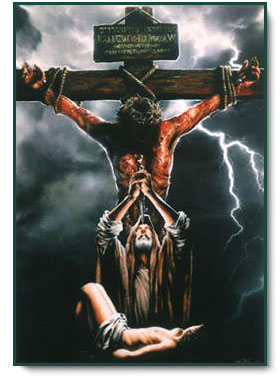
What is the most important verse in the entire Old Testament?
He wasn't necessarily seeking a right or wrong answer, he just wanted to see what we came up with. Chris gave us a couple of minutes to look through our Bibles and find what we wanted. I didn't need more than a few seconds, to tell you the truth. You see, the moment he asked that question, I had a flash of remembrance.
One of my brothers has an amazing painting, a painting linked to a verse. The verse for that painting, I knew, was the one.
It may seem silly to want to sum up the entire, massive Old Testament in one verse. After all, the Old Testament has sections on History, law, poetry, songs, philosophy, prophecy, and people-- quite a broad spectrum. I'm not really sure what Jews think of Christians using their book for our own purposes, but they probably feel as though we've hijacked their scriptures or something. Still, I often wonder if they see a universal theme, a point, if you will, for their entire canon. I know we do.
Christians, I think, should view everything in the Old Testament through the lens of Christ, and his salvation. I am convinced that the entire reason for the Old Testament is to point us to the New Testament: Jesus, and his atonement for all our sins. The Bible is one giant salvation story, a salvation arc. There is a beginning, a catalyst, rising action, a resolution, and a new beginning.
With that said, I give you the most important verse (in my opinion) in the whole Old Testament:
Genesis 22:8
Isaac, being Abraham's only child by his wife Sarah, is the child of promise. If it had not been for God's miraculous intervention, Sarah could not have borne Isaac-- she was in her 90's. Nonetheless, God speaks to Abraham one day, and tells him to sacrifice Isaac as a burnt offering to the Lord (!). Miraculously, Abraham sets out to obey God's command. Abraham and Isaac travel up to a mountain, where Abraham prepared the altar and the wood, bound Isaac, took his knife, and was about to slay Isaac when an angel stopped him, and God told Abraham not to sacrifice Isaac. Abraham then looks up and sees a ram on the mountainside, which he takes and sacrifices to God as a burnt offering, instead of his own son. God tells Abraham that because Abraham had not witheld anything from God, not even his own son-- who himself was a gift from God-- HE would forever bless Abraham, making his descendants as numerous as "the stars in the sky, and as the sand on the seashore."
That's the story most people know, but there was a critical moment before the conclusion.
Now, when Abraham and Issac had prepared the altar and the wood for the sacrifice, Isaac realized that they had nothing to sacrifice. Not knowing Abraham's intention was to sacrifice him, Isaac asked "Father, the fire and wood are here, but where is the lamb for the burnt offering?" Abraham answered Isaac by saying:
Genesis 22:8
"My son, God himself will provide the lamb"
and provide the lamb for the sacrifice, God did. Then, and forever.
Wednesday, September 22, 2010
"Just Christian"
I had a conversation with a close friend a while back. Himself a Pentecostal, he was concerned what my newly aquired Catholicism meant in a lot of ways for me, practically. He was specifically concerned with how and where I went to church, and how that would affect future decisions.
Question 1:
"For example, would you not move somewhere if there wasn't a Catholic church there?"
Of course, I briefly responded that the likelihood of that even being possible was slim to none. I'd probably have to move to the middle of West Texas, or something like that, to find myself outside of the (reasonable) reach of some Catholic church.
Nonetheless, this idea propelled us into a discussion on what it is to be "Christian first" or "Just Christian." In a lot of ways, I agree, understand, and even champion this idea. But in some ways . . . I can't help but see it as utter foolishness and lacking in circumspection. The main idea behind "Christian first" is that there is a higher loyalty to Christ than to any denomination, and that one's faith in Jesus weighs more than one's loyalty to a particular church or denomination. AMEN!
1 Corinthians 1:2
To the church of God in Corinth, to those sanctified in Christ Jesus and called to be holy, together with all those everywhere who call on the name of our Lord Jesus Christ—their Lord and ours
Now, we see from a number of passages in the Epistles that there were indeed theological disagreements among the early Christian churches. Nonetheless, what was prized more than anything else was (and still is) is faith in Jesus Christ, him crucified, and knowing God. If I were to speak to lots of Catholics (and MLP's for that matter) for a moment: you do not have salvation simply because you are Catholic or whatever else. It is more important to be a Christian (one who emulates Christ) than a Catholic, or Lutheran, or whatever.
Question 2:
"Are you a Christian who happens to be a Catholic, or just a Catholic"
Well, the two certainly needn't be at odds. Yes, it's unfortunate that there are many "just Catholics" who aren't really Christians, but that doesn't mean the real, honest-to-goodness Christians who are Catholic need to be checking their denomination-barometer every now and then thinking "Have I gone too Catholic, now? Let me get back to being Christian first." Again, they needn't be at odds.
I hope to always champion being "Christian First"-- loving Jesus more than anything else, including one's church. This even helps you relate to other Christians with whom you may disagree (hey, at least they love Jesus). When you love Jesus more than anything else, you love others who love Jesus too, despite "anything else."
BUT, I now must address the part of this idea that I called foolishness, and lacking in circumspection earlier, and that is "Just Christian"
You see
. . . there is no such thing.
Reason A: where you go to church
I grew up in a church culture where we pretended we didn't have a denomination. My Dad referred to people who really liked our denomination, the Assemblies of God, and were subsequently somewhat into the Assemblies of God, as having "AG Underwear." He also joked about some churches signs having a big AG logo on them.
We wanted to think of ourselves as above denominational practices, disagreements, politics, and the like. We wanted, really, to just love Jesus, plain and simple. A noble goal, certainly, but pretending you don't have a denomination that you have (admit it) some degree of loyalty to doesn't make you more of a Jesus-first-lover
it just makes you disingenuous about your loyalties.
After all, how many "Just Christian" people visit (much less attend) any old church they come across, as long as the people seem to genuinely love God? The funny thing I've noticed about AG-ers who are "Just Christian", when they move, etc. and look for a new church: they either find the first AG church, or one that pretends it's not AG even though it is, or one that is just like an AG church, but a non-denom-er.
Little Flower Catholic Church, where I attended up until I moved away a month ago or so, is somewhere where people really love Jesus. They may say it, show it, and act it differently, but you can tell very quickly, when you're there, that they really do love Jesus. I could tell it from the first Mass I went to there, and I wasn't even a Catholic then. Now, how many new-in-town-Evangelicals do you think would try that place out? I'm guessing, given the 'Catholic' part of the name, none. So, apparently, it's not just about loving Jesus.
To reverse question 1:
"Would you move somewhere where there was only a Catholic church?"
Reason B: what you believe
"I just follow scripture"
Those who claim this would like to think so, and you most certainly do try, but they don't follow scripture in the same way they think. Each of us, through forces far beyond our control, is indoctrinated into a particular Christian culture from the moment we recieve the faith (and often beforehand). These particular Christian cultures I speak of include certain vocabularies, practices, unspoken rules and taboos, liturgies, areas of Christianity they focus on, style of church governance, and yes: methods of interpreting scripture.
As much as a good many Evangelicals want to think, there is no such thing as a default, neutral Christianity that just follows the Bible. You interpret scripture and evaluate churches and church beliefs based on the Christian culture into which you were indoctrinated-- you cannot avoid this, it's impossible. If there is a "default" Christianity, it's Catholicism (sorry), because, after all, it's the oldest one there is. There is not, however, a neutral, Bible-only Christianity. Truly, Bible-only Christianity is itself a unique form, since it isn't practiced by everyone, and wasn't even a legitimate form, say, back in the 100's, when there was not yet a Bible, so to speak. There are only forms, traditions, and methods of scriptural interpretation, and so on; there is no "I'm just a plain Christian."
If I were to speak about this with someone who attempts this reasoning, I would have to tell them something like:
"You're an Evangelical, plain and simple. Whether you want to admit it or not, you talk like an Evangelical, worship like an Evangelical, attend Evangelical churches, and intrepret scripture like an Evangelical. If you observed an Eastern Orthodox Christian, in all his rituals, styles of prayer, and thoughts on scripture, would it not seem absurd to you if he claimed he was 'just Christian'? No, you'd want to tell him "you're not just Christian, you're obviously Eastern Orthodox."
So it is when Evangelicals attempt to brand themselves as "Bible-Christians," or something of the like.
Are you a Christian, first and foremost? Excellent. But let us not get into this business of being "Just Christian;" no one is above denominational differences, they just think they are.
Question 1:
"For example, would you not move somewhere if there wasn't a Catholic church there?"
Of course, I briefly responded that the likelihood of that even being possible was slim to none. I'd probably have to move to the middle of West Texas, or something like that, to find myself outside of the (reasonable) reach of some Catholic church.
Nonetheless, this idea propelled us into a discussion on what it is to be "Christian first" or "Just Christian." In a lot of ways, I agree, understand, and even champion this idea. But in some ways . . . I can't help but see it as utter foolishness and lacking in circumspection. The main idea behind "Christian first" is that there is a higher loyalty to Christ than to any denomination, and that one's faith in Jesus weighs more than one's loyalty to a particular church or denomination. AMEN!
1 Corinthians 1:2
To the church of God in Corinth, to those sanctified in Christ Jesus and called to be holy, together with all those everywhere who call on the name of our Lord Jesus Christ—their Lord and ours
Now, we see from a number of passages in the Epistles that there were indeed theological disagreements among the early Christian churches. Nonetheless, what was prized more than anything else was (and still is) is faith in Jesus Christ, him crucified, and knowing God. If I were to speak to lots of Catholics (and MLP's for that matter) for a moment: you do not have salvation simply because you are Catholic or whatever else. It is more important to be a Christian (one who emulates Christ) than a Catholic, or Lutheran, or whatever.
Question 2:
"Are you a Christian who happens to be a Catholic, or just a Catholic"
Well, the two certainly needn't be at odds. Yes, it's unfortunate that there are many "just Catholics" who aren't really Christians, but that doesn't mean the real, honest-to-goodness Christians who are Catholic need to be checking their denomination-barometer every now and then thinking "Have I gone too Catholic, now? Let me get back to being Christian first." Again, they needn't be at odds.
I hope to always champion being "Christian First"-- loving Jesus more than anything else, including one's church. This even helps you relate to other Christians with whom you may disagree (hey, at least they love Jesus). When you love Jesus more than anything else, you love others who love Jesus too, despite "anything else."
BUT, I now must address the part of this idea that I called foolishness, and lacking in circumspection earlier, and that is "Just Christian"
You see
. . . there is no such thing.
Reason A: where you go to church
I grew up in a church culture where we pretended we didn't have a denomination. My Dad referred to people who really liked our denomination, the Assemblies of God, and were subsequently somewhat into the Assemblies of God, as having "AG Underwear." He also joked about some churches signs having a big AG logo on them.
We wanted to think of ourselves as above denominational practices, disagreements, politics, and the like. We wanted, really, to just love Jesus, plain and simple. A noble goal, certainly, but pretending you don't have a denomination that you have (admit it) some degree of loyalty to doesn't make you more of a Jesus-first-lover
it just makes you disingenuous about your loyalties.
After all, how many "Just Christian" people visit (much less attend) any old church they come across, as long as the people seem to genuinely love God? The funny thing I've noticed about AG-ers who are "Just Christian", when they move, etc. and look for a new church: they either find the first AG church, or one that pretends it's not AG even though it is, or one that is just like an AG church, but a non-denom-er.
Little Flower Catholic Church, where I attended up until I moved away a month ago or so, is somewhere where people really love Jesus. They may say it, show it, and act it differently, but you can tell very quickly, when you're there, that they really do love Jesus. I could tell it from the first Mass I went to there, and I wasn't even a Catholic then. Now, how many new-in-town-Evangelicals do you think would try that place out? I'm guessing, given the 'Catholic' part of the name, none. So, apparently, it's not just about loving Jesus.
To reverse question 1:
"Would you move somewhere where there was only a Catholic church?"
Reason B: what you believe
"I just follow scripture"
Those who claim this would like to think so, and you most certainly do try, but they don't follow scripture in the same way they think. Each of us, through forces far beyond our control, is indoctrinated into a particular Christian culture from the moment we recieve the faith (and often beforehand). These particular Christian cultures I speak of include certain vocabularies, practices, unspoken rules and taboos, liturgies, areas of Christianity they focus on, style of church governance, and yes: methods of interpreting scripture.
As much as a good many Evangelicals want to think, there is no such thing as a default, neutral Christianity that just follows the Bible. You interpret scripture and evaluate churches and church beliefs based on the Christian culture into which you were indoctrinated-- you cannot avoid this, it's impossible. If there is a "default" Christianity, it's Catholicism (sorry), because, after all, it's the oldest one there is. There is not, however, a neutral, Bible-only Christianity. Truly, Bible-only Christianity is itself a unique form, since it isn't practiced by everyone, and wasn't even a legitimate form, say, back in the 100's, when there was not yet a Bible, so to speak. There are only forms, traditions, and methods of scriptural interpretation, and so on; there is no "I'm just a plain Christian."
If I were to speak about this with someone who attempts this reasoning, I would have to tell them something like:
"You're an Evangelical, plain and simple. Whether you want to admit it or not, you talk like an Evangelical, worship like an Evangelical, attend Evangelical churches, and intrepret scripture like an Evangelical. If you observed an Eastern Orthodox Christian, in all his rituals, styles of prayer, and thoughts on scripture, would it not seem absurd to you if he claimed he was 'just Christian'? No, you'd want to tell him "you're not just Christian, you're obviously Eastern Orthodox."
So it is when Evangelicals attempt to brand themselves as "Bible-Christians," or something of the like.
Are you a Christian, first and foremost? Excellent. But let us not get into this business of being "Just Christian;" no one is above denominational differences, they just think they are.
Sunday, August 29, 2010
Someone Else On Dual Heritage
I feel like I am in a very precarious position, one which I may very well be in for the rest of my life. I was raised in one church, very much formed in that church, and then left it for another of my own free will. What does that make me?
-Heroic, because I followed the call of God and my conscience upon my life, however painful and difficult it has been?
-An ingrate, because I left those to whom I owe so much?
-A traitor, because I soon stand to defend what I once might have denounced?
-Just a human trying my best at life, so leave me alone?
I'm certainly no longer solely a Pentecostal. On the other hand, were I to identify myself to someone as "Catholic," they would certainly and immediately conjure up a series of assumptions and stereotypes relating to my character and spirituality, almost none of which would apply to me. I've settled for the time being on Pentecostal-Catholic, but I don't even like that (If I'm not even sure what that's supposed to mean, how is someone else supposed to get it?). And how does one in this position relate to their former church, or discuss matters concerning it, and their reasons for leaving it? Certainly, I've avoided that altogether, lest I become (or even remotely sound like) certain writers and individuals I once despised, who made my decision not easier, as they thought they set out to do, but vastly more painful and difficult.
Searching through Franciscan University's library today, I came across a book called The Price of Unity, written by Basil W. Maturin. The title caught my eye, especially considering that it was shelved in what appears to be the library's ecumenism/conversion section (or so it seems to me). I'm currently reading G.K. Chesterton on the subject, but perhaps I will try this book as well. At any rate, I certainly appreciated the foreword.
B.W. Maturin, born in 1847, was an Irish-born Anglican priest and writer, who later became a Roman Catholic. He apparently died on board the RMS Lusitania in 1915 (how interesting is that??). He had some fascinating thoughts on this subject, which I took great comfort in.
You died in a fascinating and history-altering event, by the way.
-Heroic, because I followed the call of God and my conscience upon my life, however painful and difficult it has been?
-An ingrate, because I left those to whom I owe so much?
-A traitor, because I soon stand to defend what I once might have denounced?
-Just a human trying my best at life, so leave me alone?
I'm certainly no longer solely a Pentecostal. On the other hand, were I to identify myself to someone as "Catholic," they would certainly and immediately conjure up a series of assumptions and stereotypes relating to my character and spirituality, almost none of which would apply to me. I've settled for the time being on Pentecostal-Catholic, but I don't even like that (If I'm not even sure what that's supposed to mean, how is someone else supposed to get it?). And how does one in this position relate to their former church, or discuss matters concerning it, and their reasons for leaving it? Certainly, I've avoided that altogether, lest I become (or even remotely sound like) certain writers and individuals I once despised, who made my decision not easier, as they thought they set out to do, but vastly more painful and difficult.
Searching through Franciscan University's library today, I came across a book called The Price of Unity, written by Basil W. Maturin. The title caught my eye, especially considering that it was shelved in what appears to be the library's ecumenism/conversion section (or so it seems to me). I'm currently reading G.K. Chesterton on the subject, but perhaps I will try this book as well. At any rate, I certainly appreciated the foreword.
B.W. Maturin, born in 1847, was an Irish-born Anglican priest and writer, who later became a Roman Catholic. He apparently died on board the RMS Lusitania in 1915 (how interesting is that??). He had some fascinating thoughts on this subject, which I took great comfort in.
If a man is vanquished by the dialectical skill of his opponent, or by the stronger array of facts and arguments which he is able to bring forward on his side, he is not generally in a very receptive state of mind, but is probably rather looking about for other arguments and weapons of attack and defence, than laying his mind open to the force of the arguments by which he has been silenced.
And this is especially the case when the writer has once belonged to the party he attacks. It is difficult for anyone, however well intentioned, to avoid a tone that, under the circumstances, sounds offensive, and not to seem to be betraying the confidences of those with whom he has lived on terms of intimacy, and with whom he has often talked over the question. He knows exactly how these difficulties were regarded, how some of them were answered, and others were looked upon as trials that must be borne, and others again as anomalies that were not of their making, but which it was their part and their privilege to help to mend.
And it is almost impossible to avoid, at any rate, the appearance of bad taste in dragging out to the light the weaknesses and inconsistencies of a religious system that for many years claimed one's reverence and respect. The memories of religious experience do not easily pass away, and these memories are sacred, and lend some of their hallowing effect to the circumstances and surroundings in which they were felt. I have never been able to understand the attitude of mind of those who speak with bitterness, still less with ridicule, of that which once had been their religious home.
You died in a fascinating and history-altering event, by the way.
Tuesday, August 24, 2010
Verses I Wish Weren't There
We could all argue about the Bible until Jesus comes back. Seriously, we could. If a three-year journey toward Catholicism taught me anything, it's that there is no shortage of interpretations, no matter what denomination you're in, no matter who you're talking to.
Think you're interpreting it all right? Well, you're not, I guarantee it, because you have one of three ways you do it:
a) Using a system, method, or set of core values of interpreting the scriptures
b) Interpreting the scriptures however they speak to your spirit, or how seems most logical to you.
c) Ask your church what it says, and go with that.
Concerning a): every system of interpreting the Bible has a core value that it's all about, and unfortunately, they all contradict. Take for instance, the literalist method, in which you take scripture at face value, believing what it says is what it really means. The problem with this system is that people who espouse it never live it out fully. Ask a literalist if they believe Genesis 1-12 is literally true, and they'll tell you yes, without a doubt. Ask them if what Jesus said about eating his flesh and drinking his blood is literally true, and they'll say no way (argh, what are you, a heretic? A Catholic?) And I have yet to meet any Christian who thinks the Antichrist is actually going to have seven heads.
Concerning b): parts of Paul's Espistle To The Romans seem to favor this method, but are you sure? How do you know? What sits well with your spirit may not sit well with mine. Which of us has the Spirit more? Because I'm pretty sure that the same Holy Spirit wouldn't tell me and you two completely different things (or would he? hmmmm. (extremely deep line of thought that I toy with from time to time that would make you think I'm theologically nuts if I told you (but go ahead and ask me about it if you really want to know))).
By the way, good luck with Ecumenism when you try this one.
Concerning c): Makes you sound like a sheep, right? Well, maybe. You could also make the argument that you're just that humble and dead to self to the point where you need no prideful self-interpretation. You could argue it either way, but either way, you're not going bother getting your own food from scripture with this one, which will stifle your growth in Christ.
That, and a heck of a lot of Christians (and even non-Christians) won't respect you.
Now, I want to lead others to Christ with my life. For some reason, I have this crazy idea that my dumb blog could help me with that. But for this reason, as well as the fact that I feel called (like, 'one of my life-purposes' called) to promote unity between Christians of all denominations, I have consciously abstained from discussing scripture here thus far. I don't want to publicly argue with you about the Bible, plain and simple. It's too messy, and frankly, it makes Christians look like we don't love each other. Atheists mock our thousands of denominations and variance with scripture interpretation all the time, and rightly so-- if Jesus is the real deal, why aren't his followers united like he wanted them to be? Our venomous attitudes toward each other and our attitudes of superiority concerning Biblical interpretation really do kill our witness.
Nonetheless, I do have some ideas that I thought you might like. :D
There are some verses that, honestly, make Christianity really really hard, and it would be nice if they just weren't there. Do you know what I mean?
Check out Luke 6:
Moving on . . .
Going further: consider your demeanor, if you're a Christian, around your church friends, in light of this verse. I'm sure you're smiley and huggy, warm and interested, and have plenty of time for them. So am I. I love my church friends-- they're pleasant people, and make it really easy to be pleasant back. But by Jesus' standards, am I anything more than a sinner by being pleasant around these people? Not if I'm not just as pleasant, interested, and devoted to everyone else in my life (confession: I'm not), no matter who they are, or how they treat me.
And I'm not even going to get into what he says next about lending to people (hint: the US would be bankrupt in seconds if it carried out this principle). Suffice to say that we all need enormous amounts of grace and humility if we're going to live out the Gospel. And since enormous amounts of grace and humility are hard to come by . . . darn it, why did Jesus have to say this stuff?
What about you? Are there any verses that you (be honest) would be happier without?
Think you're interpreting it all right? Well, you're not, I guarantee it, because you have one of three ways you do it:
a) Using a system, method, or set of core values of interpreting the scriptures
b) Interpreting the scriptures however they speak to your spirit, or how seems most logical to you.
c) Ask your church what it says, and go with that.
Concerning a): every system of interpreting the Bible has a core value that it's all about, and unfortunately, they all contradict. Take for instance, the literalist method, in which you take scripture at face value, believing what it says is what it really means. The problem with this system is that people who espouse it never live it out fully. Ask a literalist if they believe Genesis 1-12 is literally true, and they'll tell you yes, without a doubt. Ask them if what Jesus said about eating his flesh and drinking his blood is literally true, and they'll say no way (argh, what are you, a heretic? A Catholic?) And I have yet to meet any Christian who thinks the Antichrist is actually going to have seven heads.
Concerning b): parts of Paul's Espistle To The Romans seem to favor this method, but are you sure? How do you know? What sits well with your spirit may not sit well with mine. Which of us has the Spirit more? Because I'm pretty sure that the same Holy Spirit wouldn't tell me and you two completely different things (or would he? hmmmm. (extremely deep line of thought that I toy with from time to time that would make you think I'm theologically nuts if I told you (but go ahead and ask me about it if you really want to know))).
By the way, good luck with Ecumenism when you try this one.
Concerning c): Makes you sound like a sheep, right? Well, maybe. You could also make the argument that you're just that humble and dead to self to the point where you need no prideful self-interpretation. You could argue it either way, but either way, you're not going bother getting your own food from scripture with this one, which will stifle your growth in Christ.
That, and a heck of a lot of Christians (and even non-Christians) won't respect you.
Now, I want to lead others to Christ with my life. For some reason, I have this crazy idea that my dumb blog could help me with that. But for this reason, as well as the fact that I feel called (like, 'one of my life-purposes' called) to promote unity between Christians of all denominations, I have consciously abstained from discussing scripture here thus far. I don't want to publicly argue with you about the Bible, plain and simple. It's too messy, and frankly, it makes Christians look like we don't love each other. Atheists mock our thousands of denominations and variance with scripture interpretation all the time, and rightly so-- if Jesus is the real deal, why aren't his followers united like he wanted them to be? Our venomous attitudes toward each other and our attitudes of superiority concerning Biblical interpretation really do kill our witness.
Nonetheless, I do have some ideas that I thought you might like. :D
There are some verses that, honestly, make Christianity really really hard, and it would be nice if they just weren't there. Do you know what I mean?
Check out Luke 6:
27"But I tell you who hear me: Love your enemies, do good to those who hate you, 28bless those who curse you, pray for those who mistreat you. 29If someone strikes you on one cheek, turn to him the other also. If someone takes your cloak, do not stop him from taking your tunic. 30Give to everyone who asks you, and if anyone takes what belongs to you, do not demand it back. 31Do to others as you would have them do to you.Really, Jesus? Did you honestly mean all that? Because, if I follow verses 27-31, I will become a doormat. Now, maybe the idea of this verse is that God would reward your right attitude, were you to behave in this way, and not let you come to harm if you really truly lived this out. Then again: what if God doesn't reward your right attitude. He never says he will here. Really, you get the idea from these verses that Jesus doesn't view this behavior as exemplary or notable, but simply as the way you ought to behave. I don't get the impression that (now, I could be wrong, but--) this behavior is anything more than what Jesus expects of all of us, all the time.
Moving on . . .
32"If you love those who love you, what credit is that to you? Even 'sinners' love those who love them. 33And if you do good to those who are good to you, what credit is that to you? Even 'sinners' do that.This is, for me personally, the most convicting verse in the Bible. Who honestly lives like this? Don't we all love those who love us, and do good to those who do good to us? This is especially troubling for those of us who are married, as I am, because according to what Jesus is laying out here, me loving my wife and being good to her is nothing special at all. Why? Because she loves me back, and is good to me too. It's easy to love her-- I GET LOVE BACK WHEN I DO. It's easy to do nice things for her-- SHE'S NICE TO ME WHEN I DO. Really, when I examine my own life with family and friends, what am I living for? Quid pro quo? Is quid pro quo honorable? Really, it's not. Quid pro quo is just selfishness justified with logic and in Latin.
Going further: consider your demeanor, if you're a Christian, around your church friends, in light of this verse. I'm sure you're smiley and huggy, warm and interested, and have plenty of time for them. So am I. I love my church friends-- they're pleasant people, and make it really easy to be pleasant back. But by Jesus' standards, am I anything more than a sinner by being pleasant around these people? Not if I'm not just as pleasant, interested, and devoted to everyone else in my life (confession: I'm not), no matter who they are, or how they treat me.
And I'm not even going to get into what he says next about lending to people (hint: the US would be bankrupt in seconds if it carried out this principle). Suffice to say that we all need enormous amounts of grace and humility if we're going to live out the Gospel. And since enormous amounts of grace and humility are hard to come by . . . darn it, why did Jesus have to say this stuff?
What about you? Are there any verses that you (be honest) would be happier without?
Sunday, August 15, 2010
A Long Line of Witnesses
Being a Christian since I was a small child, I received the Gospel from my parents.
My dad received the gospel from my mom. My mom received the Gospel from a friend of hers she was teaching with at the time, and her teacher-friend received the Gospel from
. . . Jesus, if you go back far enough.
But Fr. Kinn doesn't think so. He offered that it was necessary for Jesus to leave us behind so that our religion would be able to be based on faith instead of evidence; the historical Jesus had to be left behind so that we could embrace the echastological and spiritual Jesus, in faith. That got me thinking, and he's right-- Christ himself even said as much. Jesus told his Apostles that they would be better off when he left, because they would then be able to rely on the Holy Spirit, who can be with them always and everywhere.
So he left us. But in exchange, he gave his followers the Holy Spirit.
But those who do not profess Christ do not have the Holy Spirit yet (or do they? hmmm), so we must rely on our testimony to convince them. Our testimony is this: Jesus lived. And then Jesus died. Jesus was resurrected, and ascended into heaven, where he waits for those of us who love him, and for those of us who have not yet come to know him. How can we testify of this good news, of this Gospel?
Well, I would obviously say that I have felt and seen Jesus in my life, my whole life (George Strait: "I Saw God Today"-- great song). But I understand how easily that could be dismissed and explained away, and not just by those who would question my faith, but even by myself and my own hard and unbelieving heart, were my faith to be tried and fail. I've only recently come to understand this facet of my Christian faith, but there really is a much firmer and more ancient foundation than I used to realize, one that predates even the Bible.
You see, we evangelicals love to say the word witness. We love to call ourselves witnesses, and we often refer to the proselyting of our religion as "witnessing." But while I am a "witness" of Jesus' power and love, I am not an actual witness of his gospel. Neither did my parents, whom I received the Gospel from, see him, and neither did the woman my mother received it from.
And here I am. I will live, share this good news with others, especially my wife and our future children, and then pass away, leaving the message in good hands, all so they too can pass it on.
I come from a long line of witnesses. It is a very long line of witnesses, but we have been witnesses nonetheless. Each of us accepted what we heard in faith, and through that faith, we have then seen the Lord and received his salvation.
This is our faith. This is the faith that has endured for millennia, passed from generation to generation. It will continue to be passed on, from generation to generation, until all the world hears it. And then our Lord will come. We accept this in faith because, once upon a time, so long ago that it is untraceable, this faith was not faith at all, but was witnessed, founded, and then passed on. It will continue to be passed on, always and forever. This is our faith, and it will endure.
My dad received the gospel from my mom. My mom received the Gospel from a friend of hers she was teaching with at the time, and her teacher-friend received the Gospel from
. . . Jesus, if you go back far enough.
I've been thinking about this for a while now. A few months ago, it was Ascension Sunday, which takes place liturgically 40 days after Easter, hence Ascension Sunday-- the day Jesus ascended.
Anyway, Father Kinn was talking about how, ever since the ascension Sunday, Christianity has been a religion of faith. Once upon a time, if someone said to you "Who is this Jesus, anyway?" you could reply "Let's go see him. I hear he's in Capernaum right now." This would've been especially useful after he was resurrected (though it does seem like he only appeared when he wanted to at that point, when you look at the scriptural accounts). Then Jesus left us for heaven, and since then, we have had to rely on the testimony of those who witnessed him alive as a man. Some might take up the argument that Jesus really left his followers in a bind, as they were now forced to persuade people about Jesus' crucifixion and resurrection, instead of letting Jesus himself do the talking as living evidence.
But Fr. Kinn doesn't think so. He offered that it was necessary for Jesus to leave us behind so that our religion would be able to be based on faith instead of evidence; the historical Jesus had to be left behind so that we could embrace the echastological and spiritual Jesus, in faith. That got me thinking, and he's right-- Christ himself even said as much. Jesus told his Apostles that they would be better off when he left, because they would then be able to rely on the Holy Spirit, who can be with them always and everywhere.
So he left us. But in exchange, he gave his followers the Holy Spirit.
But those who do not profess Christ do not have the Holy Spirit yet (or do they? hmmm), so we must rely on our testimony to convince them. Our testimony is this: Jesus lived. And then Jesus died. Jesus was resurrected, and ascended into heaven, where he waits for those of us who love him, and for those of us who have not yet come to know him. How can we testify of this good news, of this Gospel?
Seriously, Kevin, how the heck do you know? You've only heard about Jesus because of your parents. You've never seen him. You've never felt him. How do you know Jesus did these things? How do you know he even existed?
Well, I would obviously say that I have felt and seen Jesus in my life, my whole life (George Strait: "I Saw God Today"-- great song). But I understand how easily that could be dismissed and explained away, and not just by those who would question my faith, but even by myself and my own hard and unbelieving heart, were my faith to be tried and fail. I've only recently come to understand this facet of my Christian faith, but there really is a much firmer and more ancient foundation than I used to realize, one that predates even the Bible.
You see, we evangelicals love to say the word witness. We love to call ourselves witnesses, and we often refer to the proselyting of our religion as "witnessing." But while I am a "witness" of Jesus' power and love, I am not an actual witness of his gospel. Neither did my parents, whom I received the Gospel from, see him, and neither did the woman my mother received it from.
now imagine this . . .
But 2000 years ago, a Jew named Abijah saw Jesus ascend into heaven. Then he told his wife Sarah about it. His wife told her friend Dinah about it, and Dinah told her kids. When they grew up, Dinah's kids started a new church in Asia Minor, and that church brought the message of Christ to a man named Cyrus, who moved to Italy, where he told several friends about Jesus. The grandchildren of Cyrus' friends were among the first to bring the Gospel to the Franks. 900 years later, a Frank named Guy led a Germanic, Pagan town to Jesus. 800 Years later, a man from a nearby city marries a woman from that Germanic town, where she received a strong faith from her grandmother. She leads her husband to Christ. Their children then emigrated to America, where their grandchildren settled in Chicago. A few generations later, a woman descended from those settlers began "witnessing" to a co-worker of hers. That co-worker brought the Gospel to her husband, and together, they raised their children as Christians.
And here I am. I will live, share this good news with others, especially my wife and our future children, and then pass away, leaving the message in good hands, all so they too can pass it on.
I come from a long line of witnesses. It is a very long line of witnesses, but we have been witnesses nonetheless. Each of us accepted what we heard in faith, and through that faith, we have then seen the Lord and received his salvation.
This is our faith. This is the faith that has endured for millennia, passed from generation to generation. It will continue to be passed on, from generation to generation, until all the world hears it. And then our Lord will come. We accept this in faith because, once upon a time, so long ago that it is untraceable, this faith was not faith at all, but was witnessed, founded, and then passed on. It will continue to be passed on, always and forever. This is our faith, and it will endure.
Monday, July 26, 2010
Praying for the U.S. of A.
I think Christians being involved in politics is fine.
Of course I would, right?
Really, the spirit of America and political participation is this: American citizens, who wish to change America for the better, and who represent the people's wishes, should be able to. Thus, if Christians have the support of the people, by America's founding statutes and ideals, they have every right, and moreover, a duty to participate in Government.
At least, as far as their status as US citizens is concerned, but let me speak of their status as kingdom citizens.
I come from a background where praying for the US specifically (and the world) in political and social matters is very common. My church in college had weekly prayer meetings (and daily prayer meetings, and special occasion prayer meetings, and church prayer meetings, and--) where a good deal of time would be spent to effect Godly change in these matters. My pastor would come in with several inches of spiritually disturbing news articles he had read, from which he would read snippets of to us. If we were lucky, we got through maybe a quarter of them, and we would then pray over the matters.
Usually that God would undo the bad stuff, and keep blessing the good stuff. Specifically, at the issue-by-issue level.
But enough about my old church, let's talk about ME:
You might call me a doom-ist . . . or a pessimist . . . or a nut, I suppose. Unlike my father, and most of my Christian friends, I don't believe America's best days are ahead of it. I believe our worst days, as a nation, are ahead of us. In fact, I believe the world's worst days are ahead of us. It's the end-times, baby-- things get a heck of a lot worse before they can get better, before they can be made anew. Now, I think my father, and most of my Christian friends would agree with me on that point, but in their view, America will be the light to show the way to the rest of the world; America will be the prodigal son that comes back to his father, who will then bring revival on the rest of the world to gather the harvest before Jesus returns. After all, we are America: God's nation.
But I disagree. I think we are too far gone, too godless, too liberal, too humanist, too hard of heart, too reprobate, too selfish, too spiritually dead, too dishonest, too addicted, too lazy, too afraid, too idolatrous, and essentially, doomed
. . . and I'm not so sure God didn't want it that way.
After all, he did plan out this whole "History of the World" thing aeons ago (or if nothing else, he knew how it would all play out, and is therefore still culpable in his omnipotence (phew, there's a theological battle to scratch your head over)).
If America, and the world for that matter, are going down the toilet, did God not plan it that way, in order for his saving moment, and his working anew of the world, to be that much more spectacular? Or maybe he has awesome things planned out because everything is going so bad. I cannot think of a single bad decision I've made, or bad thing that's happened to me, that good did not come of. Why should America be any different? Maybe God is using bad things to BRING US TO OUR KNEES.
And then the end will come. World: you're screwed . . . at least if you don't have Jesus.
Now, shoot, that means I'm one of those types who holds up signs about judgment on street corners, and at soldier's funerals, right? Or that I'm on my knees every night, Jonah-style, asking God to metaphorically and literally nuke our nation? No. I am not an instrument of God's echastological will (at least not knowingly)-- he's already got that stuff figured out, and I don't think he needs my advice, or lobbying. God hasn't said to me "What do you think I should do, Kevin?" He won't, either. What's my pea-brain to his universe-encompassing-brain?
Here's how I pray for America: a long sigh, followed by "God, let your will be done. If this (awful thing I've become aware of) is of you, then let it wreak havok, and if it's not, knock it down, but let your will be done." What else can I do? Haven't we all prayed for things that, years down the road, we see wasn't actually God's will? Take the 2008 election: as much as I didn't like Obama, I said not one prayer against him. How do I know how God will use him, should he win? Now, he's obviously not a Christian, and not for Christian principles, by and large, and therefore, many would draw the conclusion: he's not God's man. But maybe he is exactly God's man. Again, are we the Lord's counselors?
"Let your will be done." What more can we presume, when it comes to echastology, or the fate of our nation, and it's leaders? We vote with our conscience, through prayer, and then offer up to God our assurance that we wish for his will to be done.
Please note that I do things this way because, after all, I am a doomist. But if you disagree with me, then pray your convictions, and we will let the Lord decide
. . . and I'll see you on the other side of the tribulation.
(kidding, sorta)
Of course I would, right?
Really, the spirit of America and political participation is this: American citizens, who wish to change America for the better, and who represent the people's wishes, should be able to. Thus, if Christians have the support of the people, by America's founding statutes and ideals, they have every right, and moreover, a duty to participate in Government.
At least, as far as their status as US citizens is concerned, but let me speak of their status as kingdom citizens.
I come from a background where praying for the US specifically (and the world) in political and social matters is very common. My church in college had weekly prayer meetings (and daily prayer meetings, and special occasion prayer meetings, and church prayer meetings, and--) where a good deal of time would be spent to effect Godly change in these matters. My pastor would come in with several inches of spiritually disturbing news articles he had read, from which he would read snippets of to us. If we were lucky, we got through maybe a quarter of them, and we would then pray over the matters.
Usually that God would undo the bad stuff, and keep blessing the good stuff. Specifically, at the issue-by-issue level.
But enough about my old church, let's talk about ME:
You might call me a doom-ist . . . or a pessimist . . . or a nut, I suppose. Unlike my father, and most of my Christian friends, I don't believe America's best days are ahead of it. I believe our worst days, as a nation, are ahead of us. In fact, I believe the world's worst days are ahead of us. It's the end-times, baby-- things get a heck of a lot worse before they can get better, before they can be made anew. Now, I think my father, and most of my Christian friends would agree with me on that point, but in their view, America will be the light to show the way to the rest of the world; America will be the prodigal son that comes back to his father, who will then bring revival on the rest of the world to gather the harvest before Jesus returns. After all, we are America: God's nation.
But I disagree. I think we are too far gone, too godless, too liberal, too humanist, too hard of heart, too reprobate, too selfish, too spiritually dead, too dishonest, too addicted, too lazy, too afraid, too idolatrous, and essentially, doomed
. . . and I'm not so sure God didn't want it that way.
After all, he did plan out this whole "History of the World" thing aeons ago (or if nothing else, he knew how it would all play out, and is therefore still culpable in his omnipotence (phew, there's a theological battle to scratch your head over)).
If America, and the world for that matter, are going down the toilet, did God not plan it that way, in order for his saving moment, and his working anew of the world, to be that much more spectacular? Or maybe he has awesome things planned out because everything is going so bad. I cannot think of a single bad decision I've made, or bad thing that's happened to me, that good did not come of. Why should America be any different? Maybe God is using bad things to BRING US TO OUR KNEES.
And then the end will come. World: you're screwed . . . at least if you don't have Jesus.
Now, shoot, that means I'm one of those types who holds up signs about judgment on street corners, and at soldier's funerals, right? Or that I'm on my knees every night, Jonah-style, asking God to metaphorically and literally nuke our nation? No. I am not an instrument of God's echastological will (at least not knowingly)-- he's already got that stuff figured out, and I don't think he needs my advice, or lobbying. God hasn't said to me "What do you think I should do, Kevin?" He won't, either. What's my pea-brain to his universe-encompassing-brain?
Here's how I pray for America: a long sigh, followed by "God, let your will be done. If this (awful thing I've become aware of) is of you, then let it wreak havok, and if it's not, knock it down, but let your will be done." What else can I do? Haven't we all prayed for things that, years down the road, we see wasn't actually God's will? Take the 2008 election: as much as I didn't like Obama, I said not one prayer against him. How do I know how God will use him, should he win? Now, he's obviously not a Christian, and not for Christian principles, by and large, and therefore, many would draw the conclusion: he's not God's man. But maybe he is exactly God's man. Again, are we the Lord's counselors?
"Let your will be done." What more can we presume, when it comes to echastology, or the fate of our nation, and it's leaders? We vote with our conscience, through prayer, and then offer up to God our assurance that we wish for his will to be done.
Please note that I do things this way because, after all, I am a doomist. But if you disagree with me, then pray your convictions, and we will let the Lord decide
. . . and I'll see you on the other side of the tribulation.
(kidding, sorta)
Friday, June 25, 2010
Do I honestly know what I'm talking about?
Hmmmmmm . . . probably not.
At least not for your sake.
If this helps you and your faith, great. If not, don't feel a need to judge yourself on that. Too often do we seek validation and enlightenment from others, I think, to whom we ascribe far more authority and credibility than they are due. Take actors' opinions in politics and economics, for example.
'nuff said.
At least not for your sake.
If this helps you and your faith, great. If not, don't feel a need to judge yourself on that. Too often do we seek validation and enlightenment from others, I think, to whom we ascribe far more authority and credibility than they are due. Take actors' opinions in politics and economics, for example.
'nuff said.
Sunday, June 6, 2010
Science . . . tell me why?
This blog is probably going to tick a lot of people off, but I feel I must.
I am no apologist.
NOT AN APOLOGIST.
I don't spend much time researching Christianity, finding historical and scientific proofs of it's truths, and those in the Bible. I have read some very insightful and interesting books and essays, for sure, on that very subject, but in general, I don't know much apologetic facts. I know it's there, I just . . . don't care, I guess.
I have a friend who is a genius, and I really mean that in every sense of the world. His IQ is 160, I believe (though I realize that all an IQ test measures is your ability to do IQ tests). He teaches physiology at a prominent university, and yes, he is a fundamentalist Christian. This man has BLOWN MY MIND from time to time with historical, astronomical, physiological, etc. reasons for his belief in Christ, the validity of the Bible, and all that awesome fundamentalist stuff. My own faith has been very enriched and founded by these intellectual whoppers, some of which I have filed away in my brain, ready to be drawn out and fired like an intellectual, anti-atheist Colt 45 revolver
. . . but I don't use them.
What I am personally interested in, instead, is the philosophical, logical, moral, and emotional basis for Christianity. And indeed, you can make some very compelling arguments for belief on Christ from those standpoints. After all, what is it to be human? An entirely scientific state? Hardly. It's our characteristics aside from science (biology, physics, instincts) that make us so unique among the creatures of this planet. Good luck relating to people without addressing . . . what makes them people.
So about those intellectual, anti-atheist whoppers I have:
It's not that I don't have any use for them. I do know plenty of Atheists. I have one very good friend who is an Atheist, but believe it or not, we have never gotten into an argument concerning apologetics, and God, I hope we never do. It's not that I'm afraid to, it's just that I don't see the point. I've tried it in the past, and it seems . . . utterly futile. The amazing thing I've been learning since my old attempts to argue apologetics is the wisdom behind a phrase that you may have heard:
"People don't care how much you know until they know how much you care."
Three questions Christians need to ask themselves before sparring with Atheists:
1. Am I trying to win an argument, or trying to win a soul?
2. Which is more important?
(and the ever-applicable)
3. What Would Jesus Do?
(and no, not your hippie, relativist Jesus, the REAL Jesus whose unabridged teachings make us uncomfortable sometimes)
What do I do, instead of arguing apologetics? I live my life, as best as I can, by God's grace. I let my light shine before those who do not believe, which is really the more difficult thing to do, if you think about it, because anyone can regurgitate head knowledge, but good character is something we all fall short of-- something very hard to obtain and maintain, but very powerful. You know what cracks me up? When people ask me if I'm a Christian, and I never did or said anything to indicate it. I think this is a good thing.
Now, don't get me wrong: there is certainly a time and place for a scientific, intellectual defense of faith. BUT, it must be done with the true heart of a witness, and out of love. BUT, you must pray, or you just might fall on your face and make us all look like idiots. BUT, your goal should be to convert the soul, not to prove your point.
Remember, people don't care how much you know until they know how much you care. In fact, this is where logic and philosophy really shine, and in my opinion, trump science, because they address what it is to be human, and not just a bunch of matter smashed together. Honestly, if you reduce us to science, what's the point? We might as well kill and rape each other to ensure our supremacy, if there's nothing unique about being human, and human society.
Of course, there are those who trumpet science as the pen-ultimate of knowledge, the necessity in a world of unnecessaries, and the pinnacle of thought. These people will laugh in your face if you can't feed them science quickly and efficiently. They will dismiss all that is not based in science because, as they say, science is superior. And my response is . . .
Why?
Seriously, why is science so much better than anything else? Most people who believe science is everything can't help but offer circular reasoning for this position.
Why is science superior to reason?
Because it can be tested.
Why does testing prove science's validity?
Because testing is superior.
Maybe I'm way out of left field on this one, but seriously, why is science better? Even if testing does inherently make something superior, how do you know if you are performing the right tests? Do you have enough data to test correctly? How do you know if you're interpreting the data from your (already possibly wrong) test correctly?
Weren't great scientific minds once convinced that the Earth was flat? Or that Atoms are as small as matter gets? Or that the world only needed 7 computers? Or that Mercury pills cure many a disease?
These are all ideas that were tested by very smart people, and proven correctly . . . at the time . . . with different tests. And what, exactly, makes us so sure that we're smarter than them? Isn't it possible, and even probable that someone will come along in 100 years and use science to blow everything we know to pieces? History would say so. So why is science so gosh darn bankable if it's always changing?
Why?
If I went the 5-year-old route and responded to every defense of science with "why?" what would they say? Look at this from a witnessing standpoint: If you can't even trust the genre of reason for your faith, you probably shouldn't rely on it too much in your defense of Christ.
On the other hand, faith and love, coupled with logic, reason, and patience (something we know nothing of, unfortunately) give you a gospel that is unstoppable.
Science? No thanks. I'll defend Christ with faith and love. Try disproving those.
I am no apologist.
NOT AN APOLOGIST.
I don't spend much time researching Christianity, finding historical and scientific proofs of it's truths, and those in the Bible. I have read some very insightful and interesting books and essays, for sure, on that very subject, but in general, I don't know much apologetic facts. I know it's there, I just . . . don't care, I guess.
I have a friend who is a genius, and I really mean that in every sense of the world. His IQ is 160, I believe (though I realize that all an IQ test measures is your ability to do IQ tests). He teaches physiology at a prominent university, and yes, he is a fundamentalist Christian. This man has BLOWN MY MIND from time to time with historical, astronomical, physiological, etc. reasons for his belief in Christ, the validity of the Bible, and all that awesome fundamentalist stuff. My own faith has been very enriched and founded by these intellectual whoppers, some of which I have filed away in my brain, ready to be drawn out and fired like an intellectual, anti-atheist Colt 45 revolver
. . . but I don't use them.
What I am personally interested in, instead, is the philosophical, logical, moral, and emotional basis for Christianity. And indeed, you can make some very compelling arguments for belief on Christ from those standpoints. After all, what is it to be human? An entirely scientific state? Hardly. It's our characteristics aside from science (biology, physics, instincts) that make us so unique among the creatures of this planet. Good luck relating to people without addressing . . . what makes them people.
So about those intellectual, anti-atheist whoppers I have:
It's not that I don't have any use for them. I do know plenty of Atheists. I have one very good friend who is an Atheist, but believe it or not, we have never gotten into an argument concerning apologetics, and God, I hope we never do. It's not that I'm afraid to, it's just that I don't see the point. I've tried it in the past, and it seems . . . utterly futile. The amazing thing I've been learning since my old attempts to argue apologetics is the wisdom behind a phrase that you may have heard:
"People don't care how much you know until they know how much you care."
Three questions Christians need to ask themselves before sparring with Atheists:
1. Am I trying to win an argument, or trying to win a soul?
2. Which is more important?
(and the ever-applicable)
3. What Would Jesus Do?
(and no, not your hippie, relativist Jesus, the REAL Jesus whose unabridged teachings make us uncomfortable sometimes)
What do I do, instead of arguing apologetics? I live my life, as best as I can, by God's grace. I let my light shine before those who do not believe, which is really the more difficult thing to do, if you think about it, because anyone can regurgitate head knowledge, but good character is something we all fall short of-- something very hard to obtain and maintain, but very powerful. You know what cracks me up? When people ask me if I'm a Christian, and I never did or said anything to indicate it. I think this is a good thing.
Now, don't get me wrong: there is certainly a time and place for a scientific, intellectual defense of faith. BUT, it must be done with the true heart of a witness, and out of love. BUT, you must pray, or you just might fall on your face and make us all look like idiots. BUT, your goal should be to convert the soul, not to prove your point.
Remember, people don't care how much you know until they know how much you care. In fact, this is where logic and philosophy really shine, and in my opinion, trump science, because they address what it is to be human, and not just a bunch of matter smashed together. Honestly, if you reduce us to science, what's the point? We might as well kill and rape each other to ensure our supremacy, if there's nothing unique about being human, and human society.
Of course, there are those who trumpet science as the pen-ultimate of knowledge, the necessity in a world of unnecessaries, and the pinnacle of thought. These people will laugh in your face if you can't feed them science quickly and efficiently. They will dismiss all that is not based in science because, as they say, science is superior. And my response is . . .
Why?
Seriously, why is science so much better than anything else? Most people who believe science is everything can't help but offer circular reasoning for this position.
Why is science superior to reason?
Because it can be tested.
Why does testing prove science's validity?
Because testing is superior.
Maybe I'm way out of left field on this one, but seriously, why is science better? Even if testing does inherently make something superior, how do you know if you are performing the right tests? Do you have enough data to test correctly? How do you know if you're interpreting the data from your (already possibly wrong) test correctly?
Weren't great scientific minds once convinced that the Earth was flat? Or that Atoms are as small as matter gets? Or that the world only needed 7 computers? Or that Mercury pills cure many a disease?
These are all ideas that were tested by very smart people, and proven correctly . . . at the time . . . with different tests. And what, exactly, makes us so sure that we're smarter than them? Isn't it possible, and even probable that someone will come along in 100 years and use science to blow everything we know to pieces? History would say so. So why is science so gosh darn bankable if it's always changing?
Why?
If I went the 5-year-old route and responded to every defense of science with "why?" what would they say? Look at this from a witnessing standpoint: If you can't even trust the genre of reason for your faith, you probably shouldn't rely on it too much in your defense of Christ.
On the other hand, faith and love, coupled with logic, reason, and patience (something we know nothing of, unfortunately) give you a gospel that is unstoppable.
Science? No thanks. I'll defend Christ with faith and love. Try disproving those.
Monday, April 26, 2010
The Blood Atonement for Dummies (part 4)
The life (and death, and life) of the Son
There are many reasons that every Christian, from the greatest theologian to the simplest layman, has found for Jesus coming to live among us. Some say that it was to show us the example of how to live perfectly, even with the fragile nature of our humanity. Others say that it was so God himself could experience what it was like to be a human, so that he may understand us better (interesting, but wrong. If there is any knowledge or experience that is possible to acquire in this universe, God understands it fully, for he created the universe, all knowledge, and all experience.). Still, others believe he came to bring us a new philosophy and breadth of moral teaching for living at peace with others (Thomas Jefferson). I think there is some truth in virtually every theory, but individuals must find it themselves, and treasure it in their hearts, for these particular truths cannot be, and indeed are not, the foundational reason for Jesus' life. The foundational reason for Jesus' life is his death.
And, of course, his resurrection, but I feel unworthy to even touch that at this time.
The story of Jesus' humanity goes like this: fulfilling a number of Old Testament prophecies in his very birth, Jesus was born in Bethlehem, a small village in Roman-occupied Israel. He lived a normal life for 30 years, learning his father's trade of carpentry, and living in his community of Nazareth. When he was 30 years old, Jesus left his home and began a ministry of both teaching and healing. He traveled all over Israel, recruiting (solicited and not) many followers, all the while teaching people about sin, repentance, living morally, and the Kingdom of God (usually understood to be eternal life). During this time, he also made a number of enemies that had great power in the Jewish religion, as many of his teachings undermined or reversed what they had been taught to believe, and led people away from their authority. In order to silence Jesus once and for all, his enemies had him arrested on charges of starting a rebellion, and demanded the Roman governor have him crucified. Fearing an uprising, the governor agreed to the crucifixion, despite the fact that he believed Jesus was innocent. Suffering the most painful execution method man has ever devised, Jesus died upon the cross.
. . . for you, that is.
And here is the story of Jesus divinity: God came to Earth as a human for the purpose of saving us through his death. He lived a totally sinless life, through the power of his divinity, and then gave that life to save us all. Do you remember the Jewish method of atoning for your sins by blood sacrifice? That method, unfortunately, needed to be repeated fairly often in order to be in right standing with God, and even then, it seemed to do little as far as actually converting people's hearts toward God, and leading them to sin less. You might think that the blood of these animals (nearly perfect animals, but animals nonetheless) seems to be falling short, and you would be correct. What would be ideal here would be one sacrifice that could cover your sins forever, so you can stop this needless bloodshed. What would sweeten the deal even more would be if that sacrifice not only paid for your sins, but also changed you from the inside out so that you could sin less (and, I dare say, eventually not sin at all). This sacrifice, of course, would have to go beyond being spotless and unblemished-- it would have to be downright holy in order to pay for all sins ever committed. Well, if I didn't make it extremely obvious already, here is the kicker: that is exactly what God did.
The only truly holy one is God, for it is not by Holiness that we can define God, but God that is the definition of Holiness. He is the original form of existence. He is so much more perfect than any spotless lamb or dove, that He could pay for not only one person's recent sins, but ALL SINS ever committed, and all that ever would be. Therefore, God himself would be the only possible sacrifice that could do such a miraculous thing as paying for all humanity's sin.
Of course, God cannot simply offer himself to die as a sacrifice, for the universe would cease to exist without him. That is why he came as Jesus, who was 100% God, while being 100% Man. While Jesus lived his life as a man (eating, drinking, breathing, walking) he also lived his life as God, and it was that God-side of Jesus that enabled him to die on the cross. If Jesus died on the cross as a man, it would have done nothing, but because he, Holy God, died on the cross, we effectively received the most perfect sacrifice in the realm of possibility, for God himself was sacrificed.
Therefore, Jesus, the Son of God, God Himself, was sacrificed on our behalf. This is how his blood covered our sins: where we once took the blood of a perfect lamb and used it to pay for our sins, we now have the eternal blood sacrifice of God himself to pay for our sins. This is why we call Jesus “Lamb of God.”
He is our eternal sacrifice, our perfect lamb.
Tuesday, March 30, 2010
The Blood Atonement for Dummies (part 3)
The Law to Guide Us
or maybe to point us to something else . . . ?
It all began with Abraham; it was with him that God made a covenant, thus creating Judeo-Christianity. From there followed his son, Isaac, and grandson, Jacob-- these three are known as the "Patriarchs;" Judaism, Christianity, and Islam all claim heritage from the Patriarchs. Jacob, whom God renamed "Israel" had 12 sons, whose decedents made up the 12 different tribes of Israel. When Moses led the twelve tribes of Israel out of Egypt, God dictated to Moses the Hebrew Law.
At the top of the law is the 10 Commandments. These are the serious, tip-top rules for following God, and avoiding his wrath. The 10 Commandments have endured throughout History, and form the basis (whether you like to admit it or not) for much of what we know as civil law today. After the 10 Commandments come 613 laws, also given to the Hebrews from God, through Moses. These laws are found in the Pentateuch (the first 5 books of the Bible), and consist of 365 negative commandments, and 248 positive commandments.
-The commands range from moral issues, such as:
"Don't have sex with your mother/father" or "Don't extort money from the poor"
-theistic commands, such as:
"Love God above everything else," or "Do you best to emulate God's qualities"
-and ceremonial and ritual practices, such as
"Don't trim your sideburns," or "Don't eat meat and milk mixed together."
(If you want to see every one in a list, Wikipedia has compiled one)
This law taught the Jews how to live morally, and how to please God. Some of them, even though they seem strange and pointless, actually have very practical uses. God's wisdom is truly reflected in these laws, as you'll find rules that cater to things like germ theory, which mankind didn't even begin to understand for another 2000 years (This had to be from God, clearly. How else would the Jews have thought of that stuff?). But there is a huge problem with these 613 laws: NO ONE can POSSIBLY follow them perfectly. Once again, following the law to a T is IMPOSSIBLE.
However, the law also accounts for this, and in its fairness, it allows you to atone for your sins and failures to follow it in a number of ways, such as forgiving the debts of those who owe you bigtime. Still, the primary way to atone for your sins in Hebrew law is to offer animal sacrifices. There is a good deal of time spent in scripture discussing how these sacrifices are to be made, and in those scriptures, it becomes obvious that the thing of most importance is blood.
What kind of animal does the blood come from?
What qualifies a particular animal to be sacrificed?
How do you kill it?
Now use the blood in a ritual.
How much blood do you use?
Where does the blood go?
What happens to the bloodied things afterward?
See? For the Jews, it's all about blood when it comes to atoning for your sins before God.
Interestingly enough, the Old Testament, which people love to rag on for being antiquated, judgmental, and ritualistic to no end, actually says that this is all pointless. If you read Psalms, you'll notice it said a number of times that God really doesn't want blood and sacrifice. That's not what he's really after at all. What God really wants is your heart-- he wants you to have a humble spirit before him, and love him just as he loves you. If you truly love him, he doesn't care whether or not you offer sacrifices. Also, for a religious text that people typically associate with anger and judgment, you'll find references to God loving you and loving his people quite often, even in the books of law. Food for thought
. . .
The blood, of course, could only come from certain animals, such as doves, bulls or lambs. And it couldn't be any old animal, either-- your sacrifice had to be the best of the best, with no defects, diseases, or spots. If you were sacrificing a lamb, for instance, it's coat had to be perfectly white and spotless. Interesting regulation considering this perfectly white animal was about to be completely stained with blood. Had enough talk about blood yet?
Fast forward a thousand years or so, and we come to the birth of Jesus. I'm not going to get into how exactly we know that Jesus is the Son of God--this blog isn't about apologetics--so just accept that by faith for now so that you may understand the overall message. I may address Jesus' incarnation at another date. This time, I'm not going for how Jesus came to be, but why.
Subscribe to:
Comments (Atom)